The Product Line
If there is a start, it was in 1965, when HP Labs in Palo Alto near San Francisco started with two completely different projects.
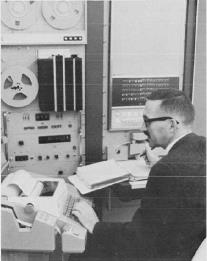
The 2116 Minicomputer
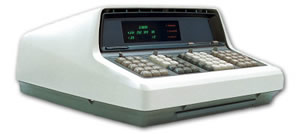
The 9100A Calculator
Both projects were practically independent of each other. Production of the 2116 was started one year later in the HP's minicomputer division, located at Cupertino, California. Production of the 9100 began in 1968 in HP's Loveland Division in Colorado. The 9100 was a fairly sucessful product, however the architecture of the 9100, although ingenious for the time, was inadaquate for the necessary up-scaling towards larger memory capacities, versatile I/O and more flexible programming.
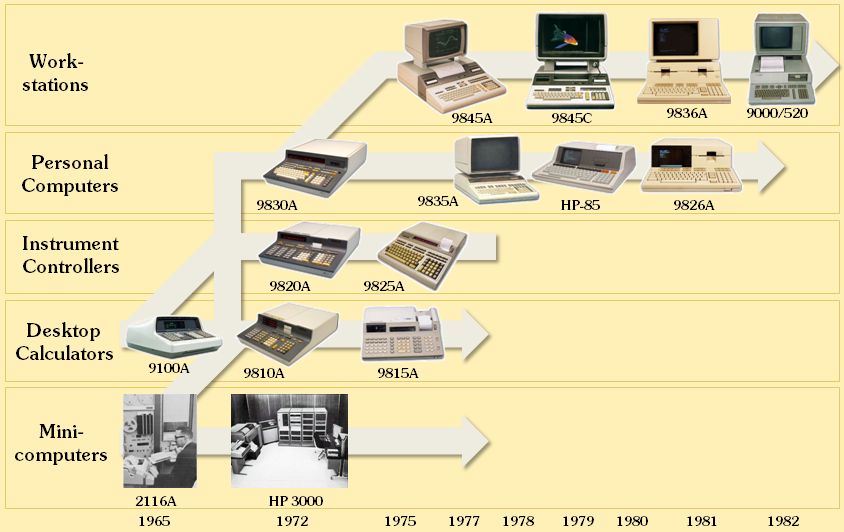
Timeline
When looking for a successor for the 9100, the desktop computer division in Colorado decided to back on the proved processor design of the 2116 in order to develop a complete new family of desktop calculators, the 9800 series. Now the 2116 with its 16-bit architecture was a bit too heavy to be implemented in the case of a desktop calculator, so HP's R&D serialized the 16-bit architecture down to single-bit/single-digit processing, which required a much simpler design. However, compared to the 2116, not only the size, but also the performance decreased dramatically.
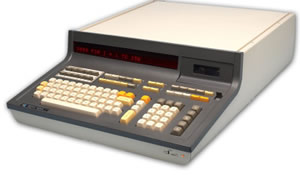
The 9830A
So both development lines, the minicomputer development and the desktop calculator development, met in HP's 9800 series of desktop calculators. And actually, the 9820 and 9830 already could be considered much more as desktop computers than calculators. The 9810 was introduced in 1971, and the 9820 and 9830 were introduced in 1972. They sold remarkably well, and HP decided to continue the line with another generation of desktop calculators, the 98x5 systems.
Although not really prooved, it seems obvious that there was some competition between HP and WANG Laboratories, which started by grabbing a large share of WANG's position in the market of desktop calculators with the introduction of the HP 9100. From now on, each time WANG tried to catch up with its calculators, HP was a bit faster and delivered an even better product. However, WANGs market strategy had a strong focus on real computers, and when the 2200 minicomputer was released in 1973 with its CRT display, its instant-on capabitilites and its fast BASIC performance (all the BASIC firmware was micro-coded!), HP had to make a significant step forward.
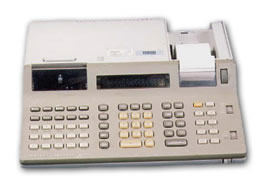
The 9815A Calculator
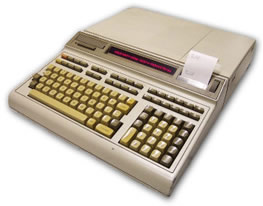
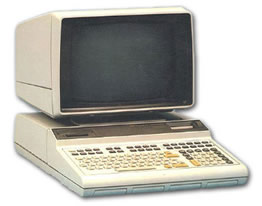
9825A and 9835A Desktop Systems
Whereas the 9815 was mostly a programmable calculator, the 9825 was intended as an instrument controller (and most 9825 systems sold were used exactly for that purpose). The 9835 (code name "Raven") featured a CRT display as alternative to the LED matrix, and was programmed in HP BASIC instead of HPL, but actually the 9835 did'nt have a real target group, since it was a bit too expensive as a plain instrument controller, and not as performant as the 9845 for serious engineering applications. And probably most important, the 9835 did not offer a graphics option. Both the 9825 and the 9835 used a single built-in cartridge tape drive as standard mass storage and a small thermal printer with 16 characters per line as an option.
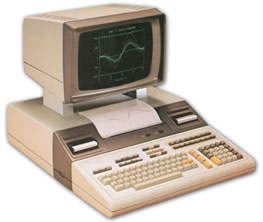
The 9845A
The 9845C
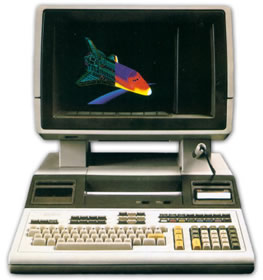
The 9845B was introduced in 1979/1980, and was mostly a redesign of the original 9845A, allowing a larger amount of read/write memory. According to Joe Rigdon the 9845B had the development code name "Galleon". In fact a pun (the 9845B had been designed to hold four times the memory compared to the 9845A, and there are four "Qwerts" in a "Galleon" :-). The 9845C was introduced at the end of 1980 and provided sophisticated color graphics with hardware accelerated vector graphics and a light-pen as pointing device. The color monitor, which had an estimated 98% part on the innovations of the 9845C, had the development code name "Odyssey". I'm not sure about the origin of that name, however it seems that Colin Cantwell, who supported the design of the 9845C, also participated in the making of the "2001 - A Space Odyssey" motion picture. In 1982 a bit-slice implementation of the language processor with the code name "Steamer" was offered, which was a replacment for the original LPU hybrid processor and was capable of executing time consuming BASIC instructions in microcode, which could accelerate the execution of BASIC programs up to a factor of seven.
The systems equipped with this new bit-slice processor were indicated as "option 200" models.
Sometimes, the 9845 systems are referred to as "desktop computers", and sometimes as "desktop calculators". Even the original 9845A patent is titled "programmable calculator". Although there is no official statement, the most plausible rumour seems that HP once realized it could do lots of business with public administration but the regulations for computer acquisitions required public tenders, which was not the case for calculators. Others tell it had been motivated by export facilitation. But maybe it were really the 9100 roots and the facility where the 9845 had been designed which caused the early calculator classification.
By the year 1982, 13,000 9845 series units were sold. In the year 1985, HP claimed a combined worldwide installation base of 85,000 units for the 9825 and 9845 series. With an estimated total of 28,000 9825 units, this works out to about 57,000 9845 units. It really sold like hotcakes.
The "9855A"
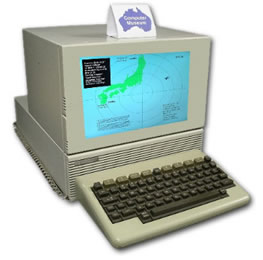
According to the hpmuseum.net, the last and most-performant member of the 98x5 series, the 9855A, was developed as a top-secret project exclusively for the U.S. Department of Defense, and never sold commercially. It was a completely independent project and had less in common with the other family members. The 9855A was ruggedized and included completely redundant subsystems. It featured an HP developed 32-bit CPU, an 800 by 600 graphics display with 64 colors, 1 MB of non-volatile RAM and an integrated hard disk drive. About 11,000 units were built for the DoD with many of them used in the U.S. Navy, and only one single known system is left (see the hpmuseum for details...).
However, with a closer look, the main system case looks pretty much like a 9000/300, the keyboard is that of a 9920, and the CRT, hmmm I could swear it has something of a 7942A/46A tape/disk combo, and the screen looks somewhat odd... see the HP9000/520 below for the real HP9855.Although the 9845 desktop systems were full-fledged computers with a CPU based on the 2116 minicomputer architecture, they still had lots of design elements from the original 9100 calculator, like the BCD floating point arithmetics hardware and the instant-on ROM based system firmware.
The 9836
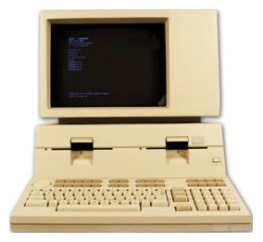
In 1982 the 500 series was launched, based on HP's first 32-bit CPU, the 32-bit FOCUS processor. The FOCUS had a microcoded stack based CISC architecture derived from the HP 3000 and - according to Wikipedia - been "the first commercial, single chip, fully 32-bit microprocessor available on the market" . The 500 series computers were introduced as "HP 9000" computers (shortly after the introduction, the 98x6 series was changed to include the "HP 9000" name). Although the series 200 were technically the first HP workstations which could be used with HP-UX (HP's own UNIX implementation) as operating system, the series 500 were the first models which were sold with this operating system. There were four different casings, the 9000/530 was a 19" rack-mount system, the 9000/540 was built into a mini-cabinet, the 9000/520 was the desktop variant and the 9000/550 already had the industrial design of the 300 series.
The 9000/520
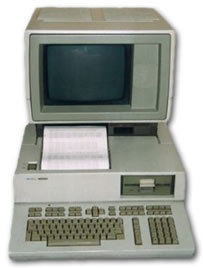
All models contained a 10 MB hard disk drive. The model 520 desktop version also included a 5.25" floppy disk drive and could be alternatively used with HP Basic. The 500 series was designed for downward compatibility with the previous HP 200 series and the 9835/9845 systems and supported both the 9845 and the LIF file system in addition the newly developed Structured Directory Format (SDF). Many programs originally written for the 9835/9845 or 98x6 could be executed on the series 520 without change. One interesting fact ist that much of the OS (both HP-UX and Basic) was developed in parallel to the series 500 hardware design using an emulator running on an HP9845 with Assembly Execution and Development ROM. The original product number of the HP9000/520 had been 9855 (and so the core part numbers of the system PCBs all start with 09855-), which confirms the 9000/520 was fully in the tradition of the 98x5 product line.
The hardware architecture was a consequent improvement of the 9845 system in many aspects. Both the 90770A and 98780A display tops were re-used from the 9845 option 200 systems with a special display interface board ("DIM"), and another display option, the 98760A, re-used the display techniques of the HP9836C based on standard chips, with a real look-up table and up to 16 colors out of 4096 which could be displayed at once. The main advancements on the hardware side were the development of a new chipset (including the 32-bit CPU, an I/O processor, a memory control unit and a new DRAM chip with hardware error correction), a new way to produce high-density multi-layer PCB modules with surface mounted components (called "finistrates"), and the capability to operate up to three 32-bit processors in parallel (real multiprocessing). Due to the decision to pack everything still into one single desktop housing, the model 520 was the biggest and heaviest desktop system ever produced by HP (74 kg for the color system).
The workstations series was continued with the 300 series (1985) with HP BASIC, Pascal and HP-UX as valid options, and, after the acquisition of the workstation manufacturer Apollo, the 400 series (1990) and 700 series (1991), all based on HP-UX.
There was a side line of microprocessor based personal computers, starting with the 80 series of BASIC computers in 1979, and continuing with the 100 series, which first introduced CP/M and then MS-DOS, and finally the Vectra family of IBM PC compatibles.