The 9845B/T
 The 9845B was a revised version of the 9845A, announced first in the 9845B sales brochure from 1979 and introduced in the 1980 catalog. The 9845B was HP's top-selling System 45 model. It took a noticable part in HP's revenue of that time. Most of the 9845 systems which are still available today are 9845B models.
The 9845B system architecture was the final system architecture for all 9845 systems. Modifications were from then on performed only to single assemblies and most important, the CRT display.
In analogy to the 9845A, it was available in three configurations:
- The 9845B, a basic configuration with 64 KBytes LPU R/W Memory, one tape cartridge drive and no internal printer, and
- the 9845T, an expanded version with two internal cartridge drives, a built-in thermal line printer, and 192 KBytes of LPU R/W memory, and graphics support.
- A specially shielded TEMPEST edition based on a standard 9845B
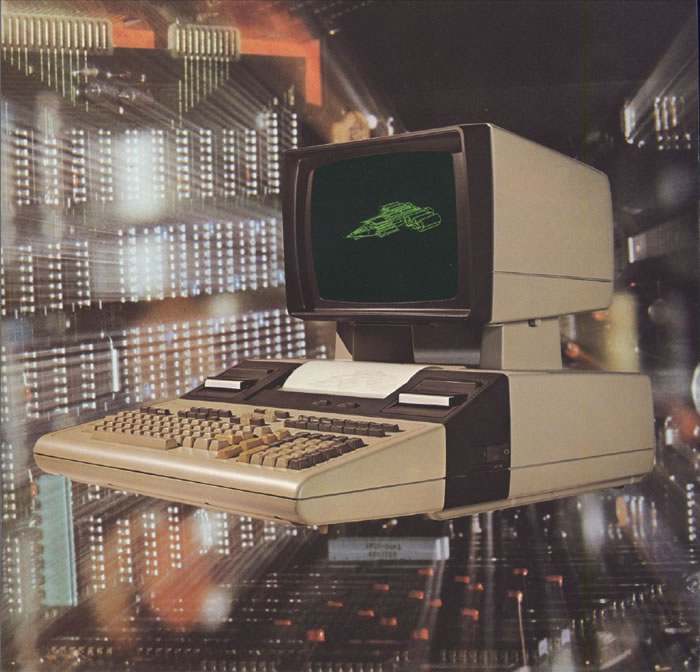
The enhancements of the 9845B included both changes in hardware and in software:
- a newly designed motherboard with separate system buses for the PPU and the LPU
- separate processor assemblies for the PPU and the LPU with processor, memory address extension and memory controller
- internal system ROMs on combined RAM/ROM assemblies (instead of ROM drawer modules), one for the PPU and one for the LPU
- 128 KByte and 512 KByte R/W expansion assemblies instead of 8 KByte and 16 KByte R/W memory boards
- redefined use of the HLT bus signal (now mirroring the CRT vertical retrace)
- a couple of new BASIC commands (CAT TO, ON KBD, OFF KBD and KBD$)
- revised system firmware
- revised file formats for all file types except DATA and BDAT
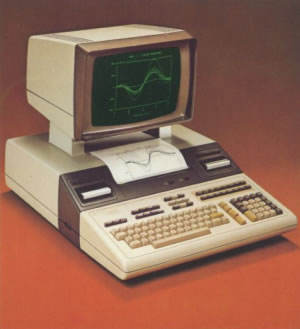 The 9845B and the 9845C mainframes were almost identical, the main differences were the color display, the color coded special function keys and a new graphics firmware. So, as long as no color graphics were used, programs for the 9845B and 9845C were directly interchangeable. With the 9845B, the 9845 series reached a stable base architecture.
In 1982, the so-called option 200 models were introduced on both the 9845B and the 9845C lines. The enhancements for the 9845B Option 200 were a new power supply unit, a bit-slice LPU and the hardware accelerated, monochrome 98780A graphics CRT monitor with light pen. Size and acceleration features of the 9845B Model 200 CRT were very similar to that of a standard 9845C, however reduced to bi-level images and deriving power from the 9845B mainframe PSU. Since the 9845C graphics already were hardware accelerated, the enhancements for the 9845C Model 200 were limited to a new power supply unit and a bit-slice LPU.
Just like the 9845C with its 98770A color CRT monitor, the 9845B option 200 provides eight soft-keys built into the monitor for user-friendly menu selections. The soft-keys are software-labeled, and for that purpose the original 25 line capacity of the display is extended to 28 lines.
Note that HP 9845 option 200 and HP 9845T is not the same.
Most commercial software (by far) was developed for the 9845B/C models, see the software section for an overview.
Technical Specifications
|
|
Model 100 Close Up
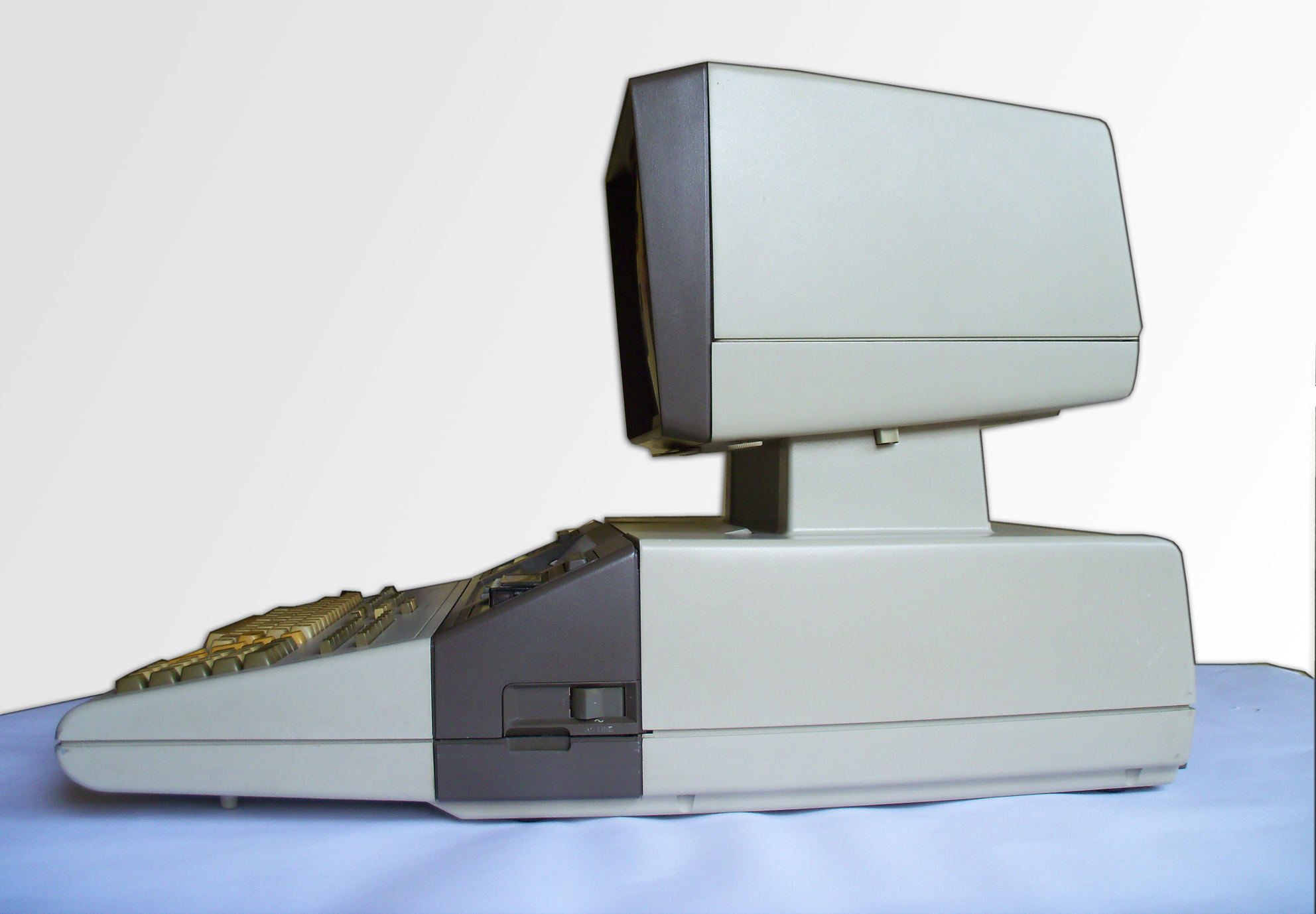 |
The 9845B workstation had been designed as an integrated desktop solution with keyboard, CRT monitor, thermal printer and two cartridge tape drives in one single system. The whole design, although highly integrated, still is quite serviceable. Every component can be accessed with only a few steps. |
 |
The main housing is built completely from molded plastics with internal metal coating for proper EMI shielding. The power switch for the whole system and the adjustments for the CRT monitor are both located on the right side of the system. |
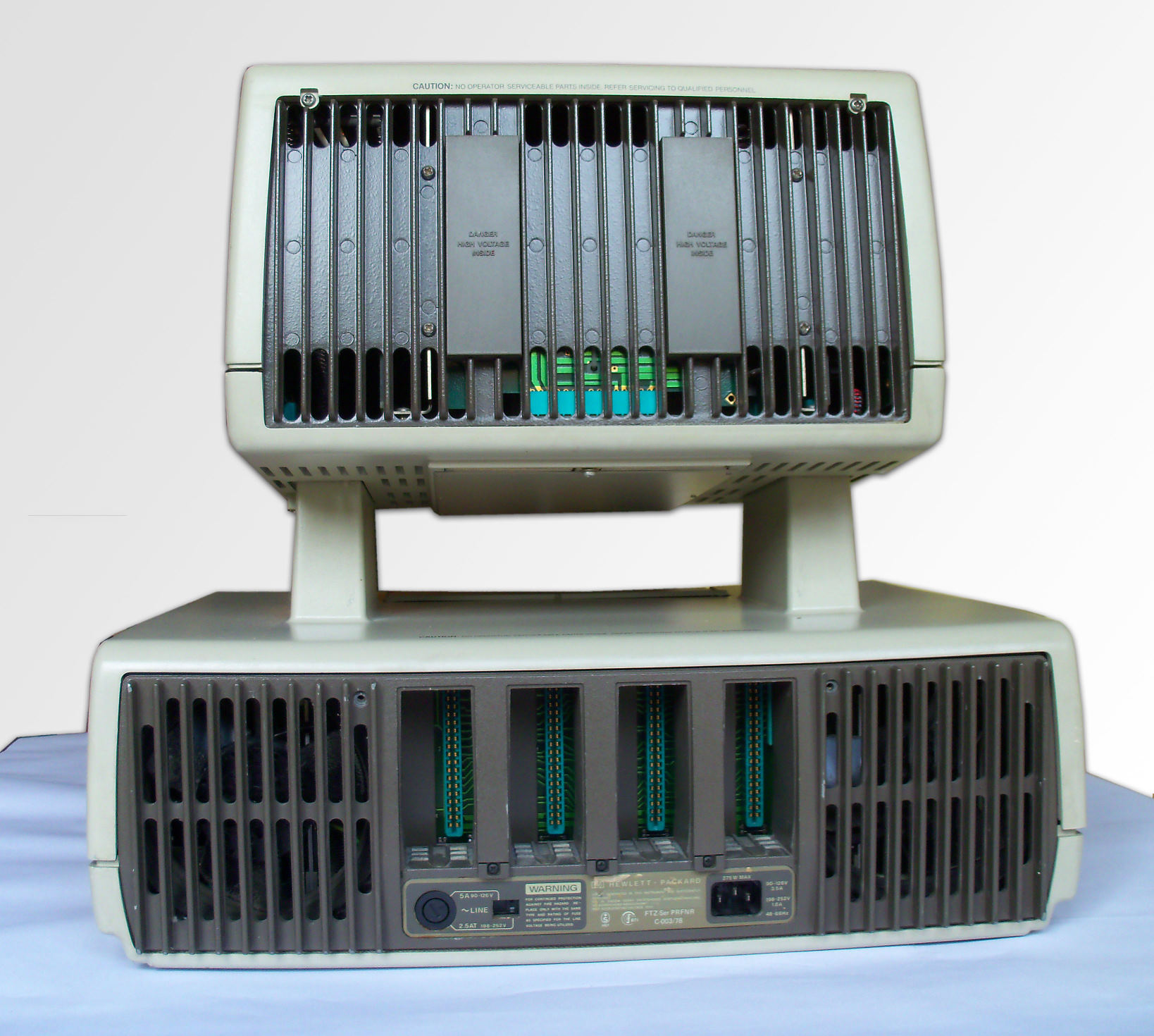 |
Due to the integrated design only a few cables are needed. All connections have been positioned at the back of the system, so no cables are visible to the user and everything looks quite tidy. The 9845 provides a connector to AC power and four I/O connectors for expansions like interface modules. Because of the high number of components and the resulting high power consumption, a cooling flow of air is guided from the front through the whole system and exhausted by two fans mounted in the back of the system. The thermal design made it possible to pack all the boards tightly together. The standard monitor is passively cooled by convection. |
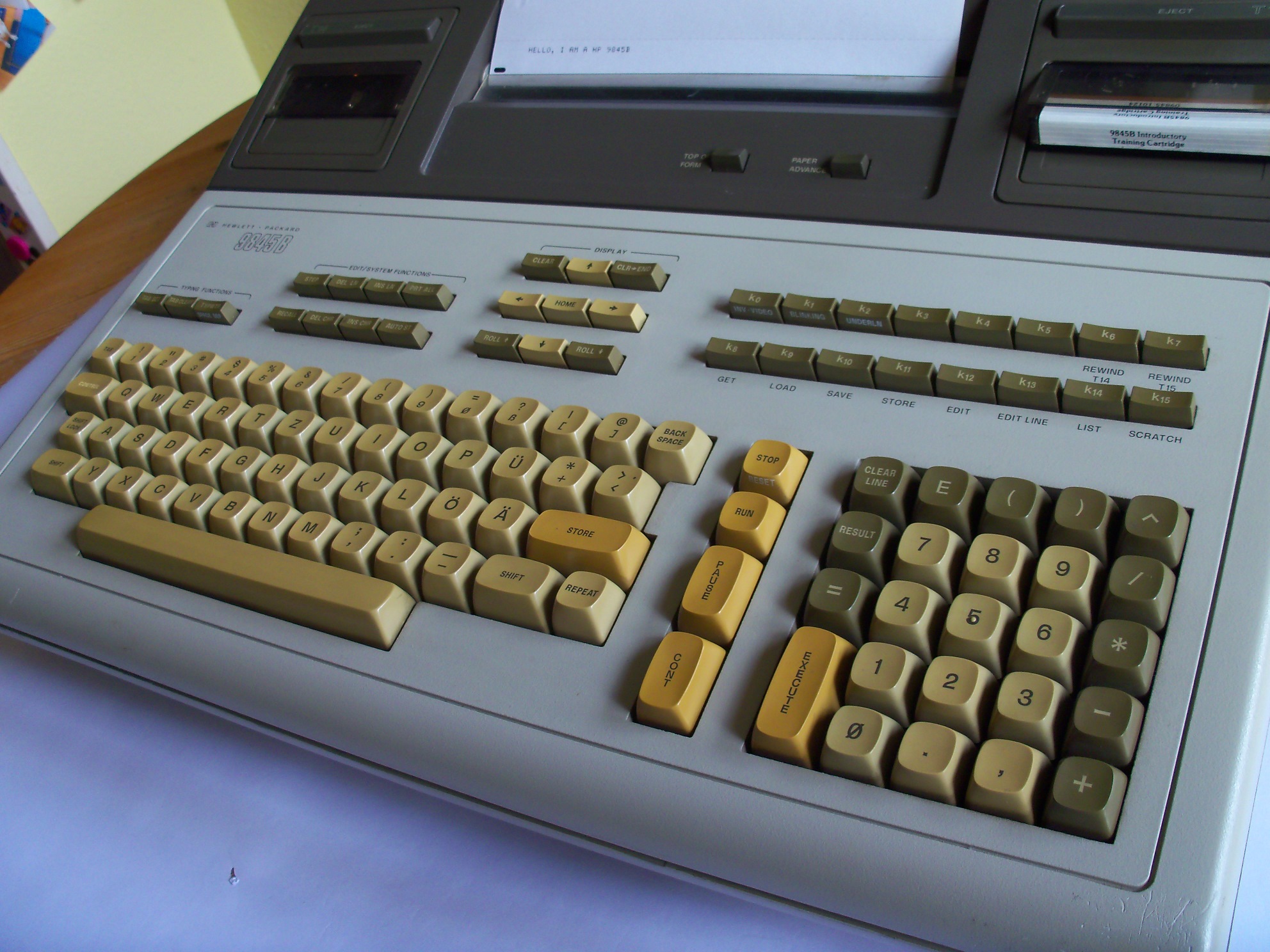 |
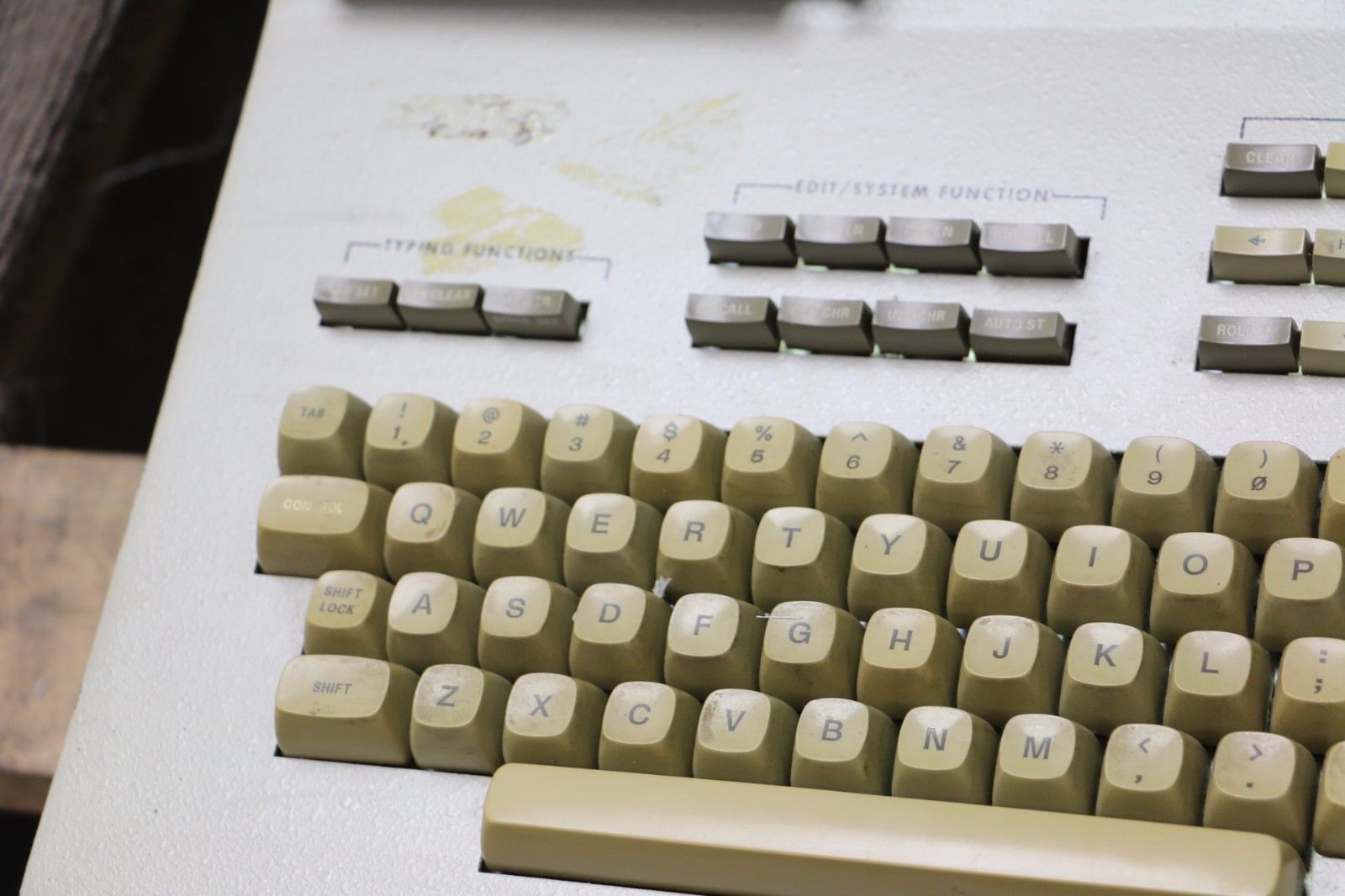
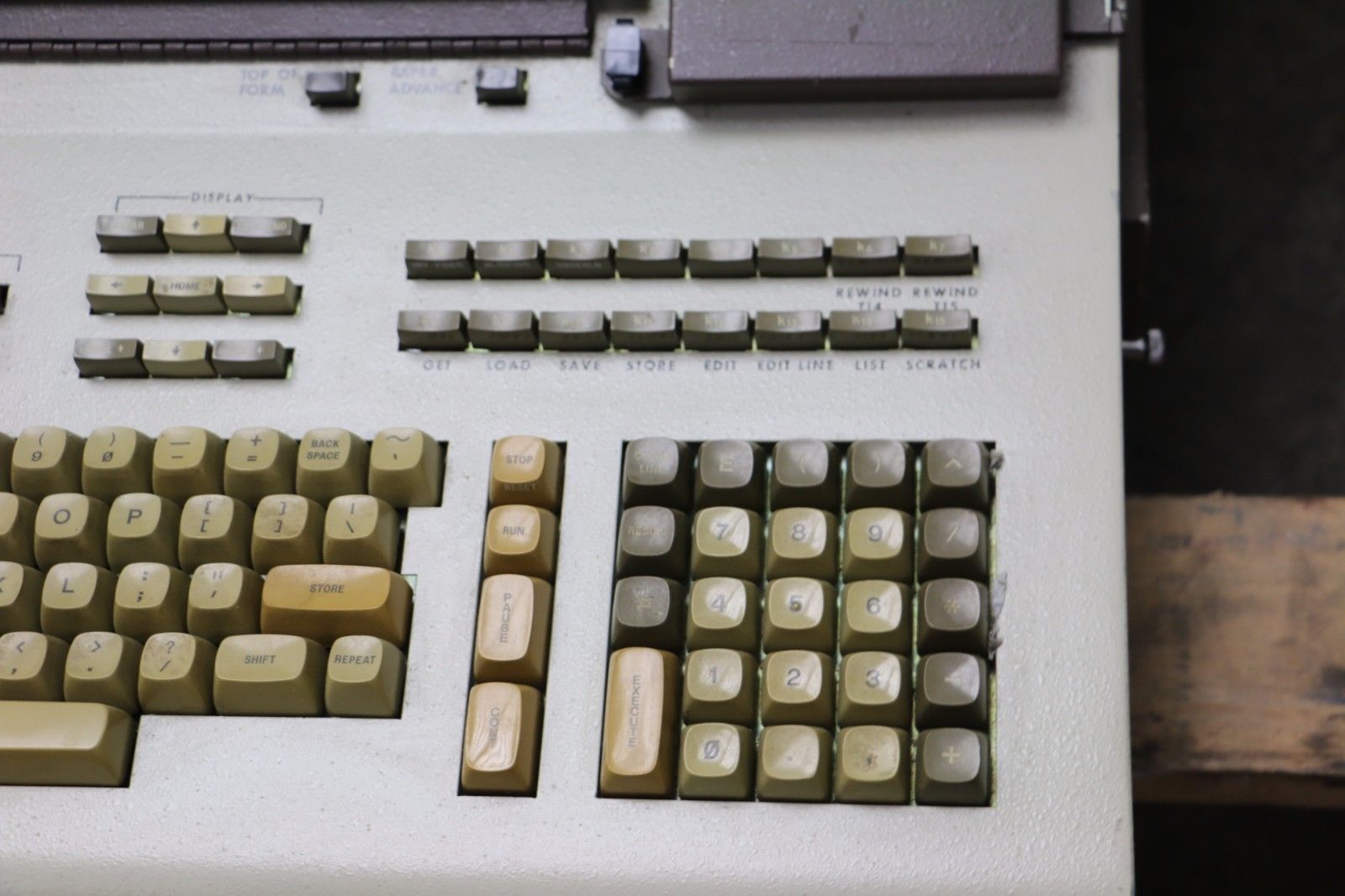
The 9845B keyboard includes a standard Selectric-type alphanumeric key block, a separated numeric key block, a number of special function keys which can be assigned by the user to any key sequence macros, and several special keys mainly for editing and system control. All keys have a high-quality mechanism suitable for fast and comfortable typing. Keycaps are the same as for the 9825 and 9835, however the switch mechanism had been enhanced. I do not own a single 9845 keyboard with non-working keys. |
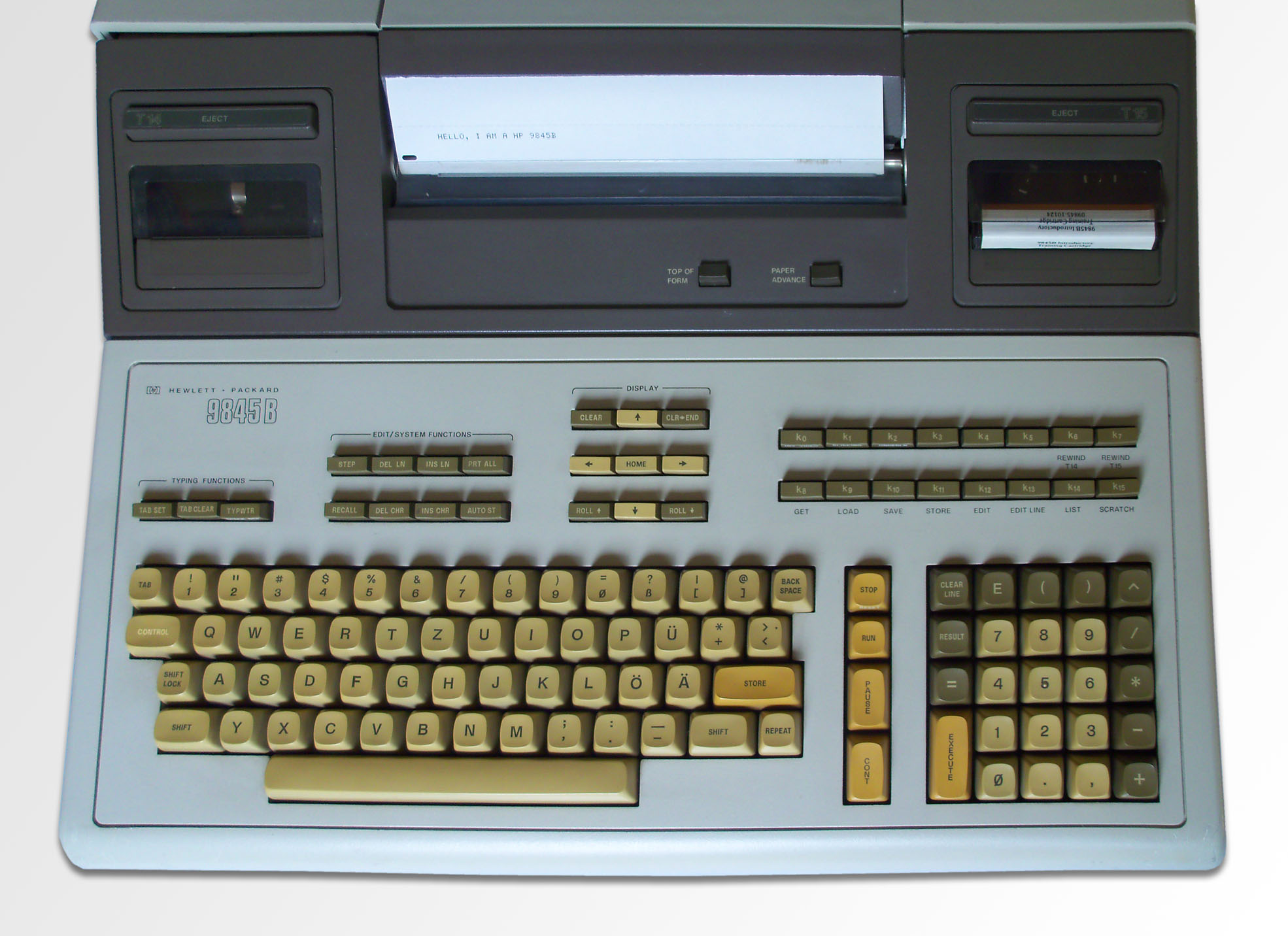 |
The 9845 could either be ordered as 9845B base system with single cartridge tape drive and without printer and then upgraded as needed, or as complete system with two cartridge tape drives an thermal printer already installed. |
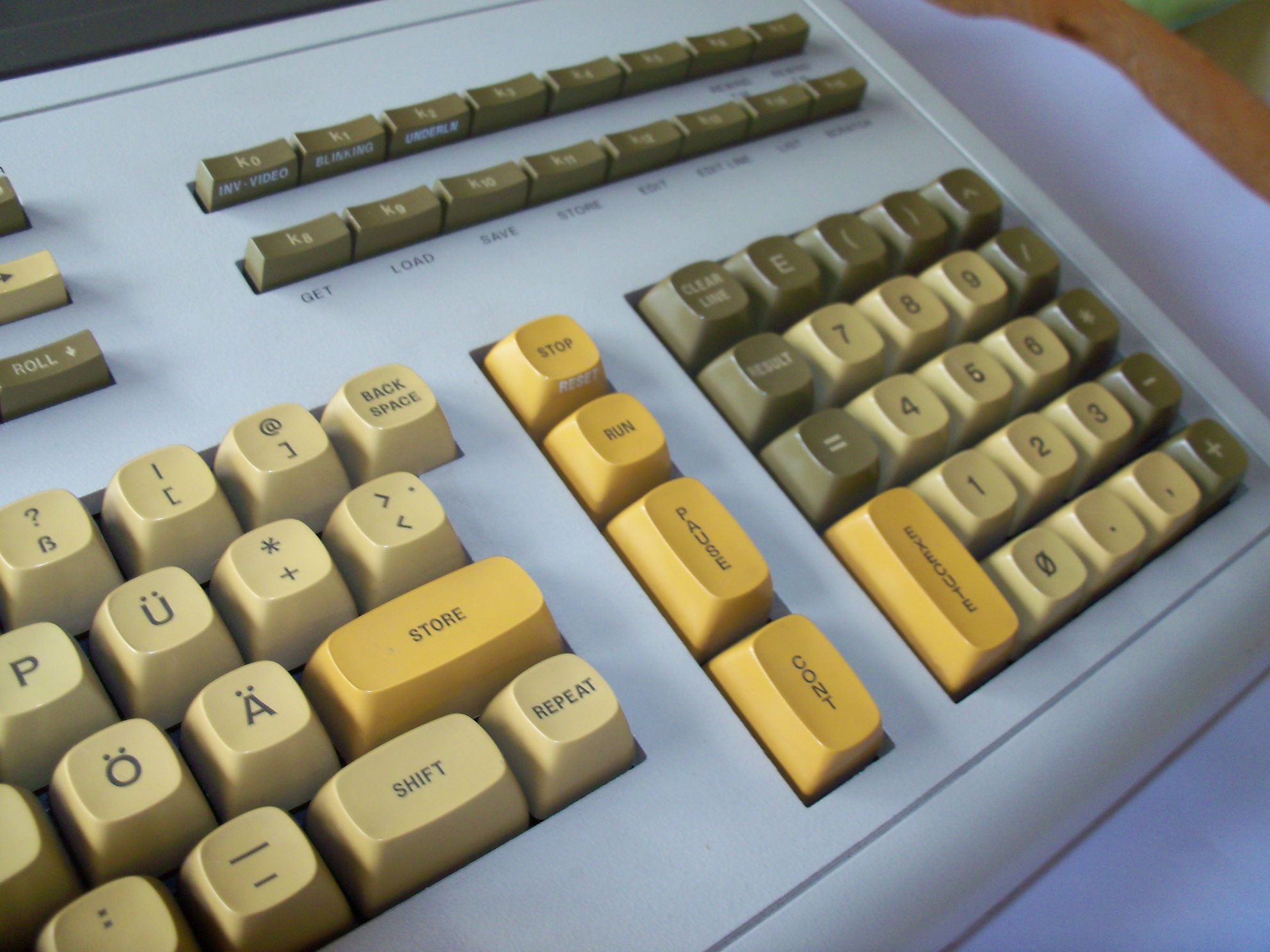 |
In the middle between the alphanumeric key block and the numeric key block is a row of frequently used system control keys. While the normal PC's Enter key combines several functions like "input done/continue", "store" or "execute", the 9845B has one key for each of these functions. Also there are individual keys for running or pausing a program. The special function keys above can be either used for functions defined by a program, or can be user assigned with arbitrary key sequence macros.
|
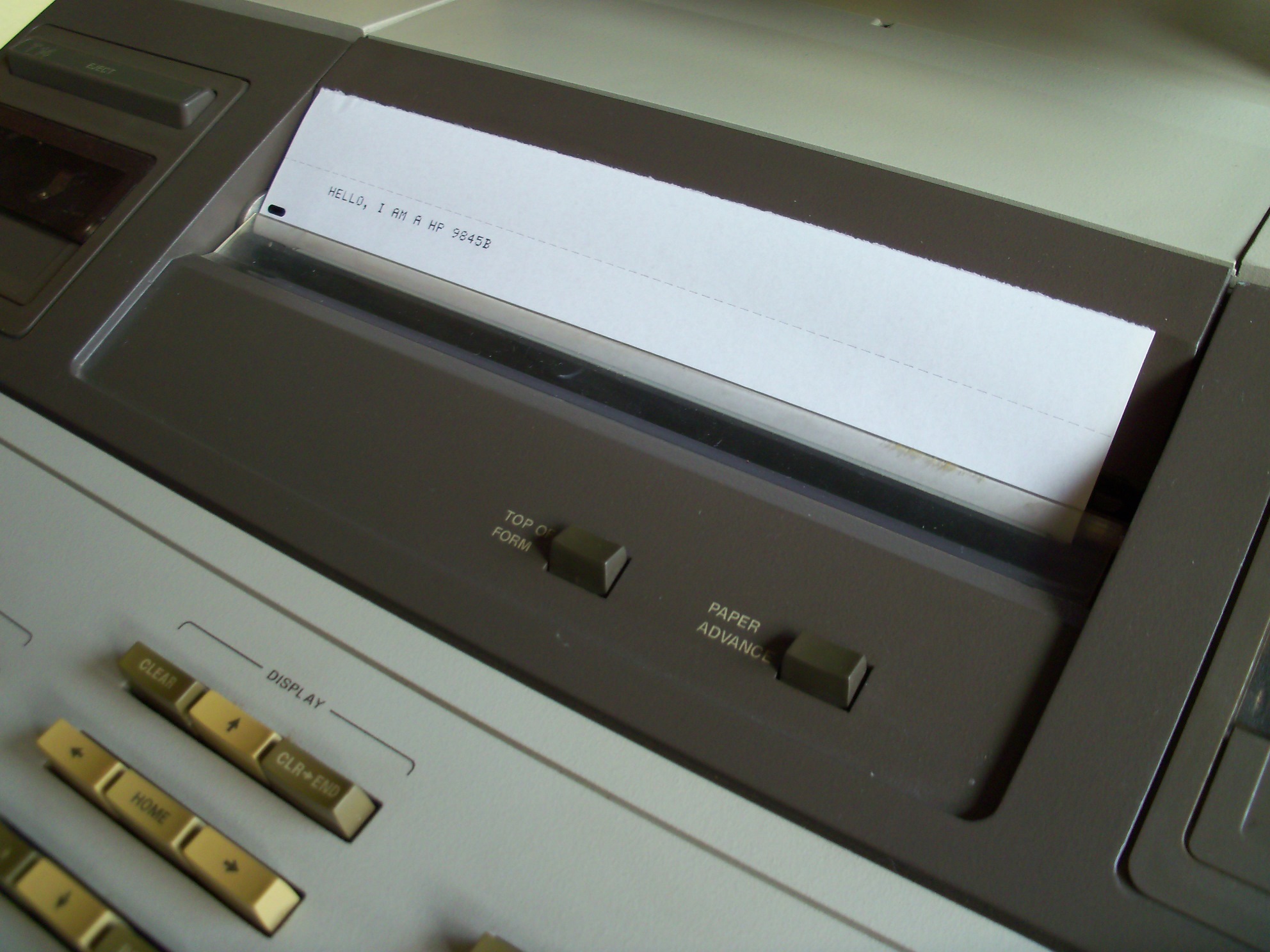 |
The 9845B could be ordered with a built-in, 80 character wide thermal printer. The printer can be fed with any standard fax thermal paper on paper roll. The printer is pretty fast (up to eight pages per minute), and can also print 560 pixel wide dot matrix graphics such as screen dumps. If the paper has page index holes (for positioning at perforation), the 9845 recognizes them. Two keys can be used to advance paper either by one single line or up to the start of the next page. After finishing printing, the paper can be simply cut off. |
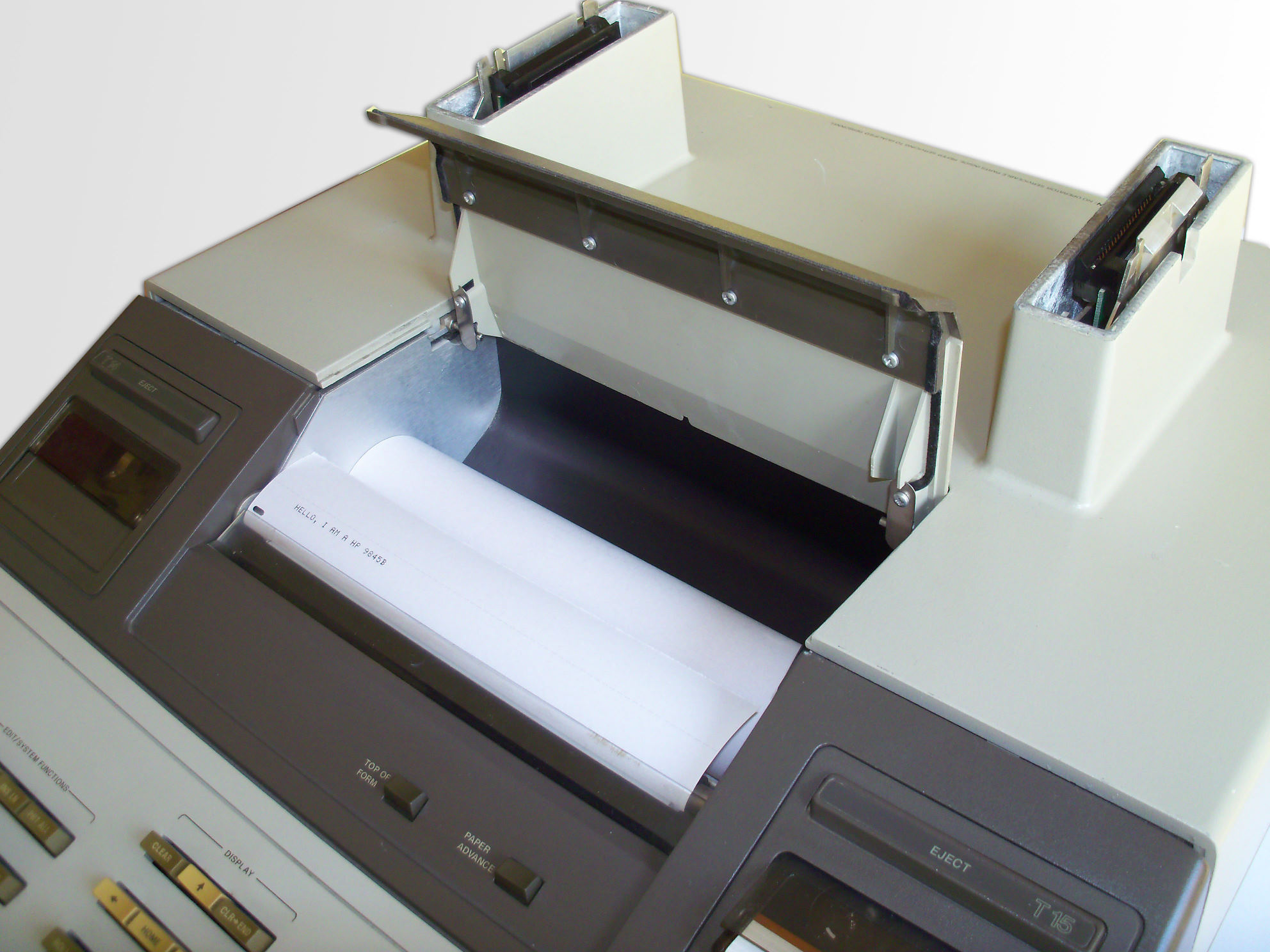 |
The paper tray holds a single paper roll. The thermal paper is guided by transport rollers. There is a lid over the paper tray, which can be detached (which unfortunately results in many system with missing lids today). |
 |
The cartridge tape system had been quite sophisticated for the time. It was extremely fast (at least compared to compact cassette solutions) and (30 years ago) also quite reliable. The cartridge tapes have almost the same form factor as the more recent QIC 40/80 cartridges, and were much more handy than the 5.25" or 8" floppies of the time. The 9845 could use a special command to save the full machine state on tape (somewhat like the suspend-to-disk function of modern systems), so that work could be continued even after powering the system off and on again. |
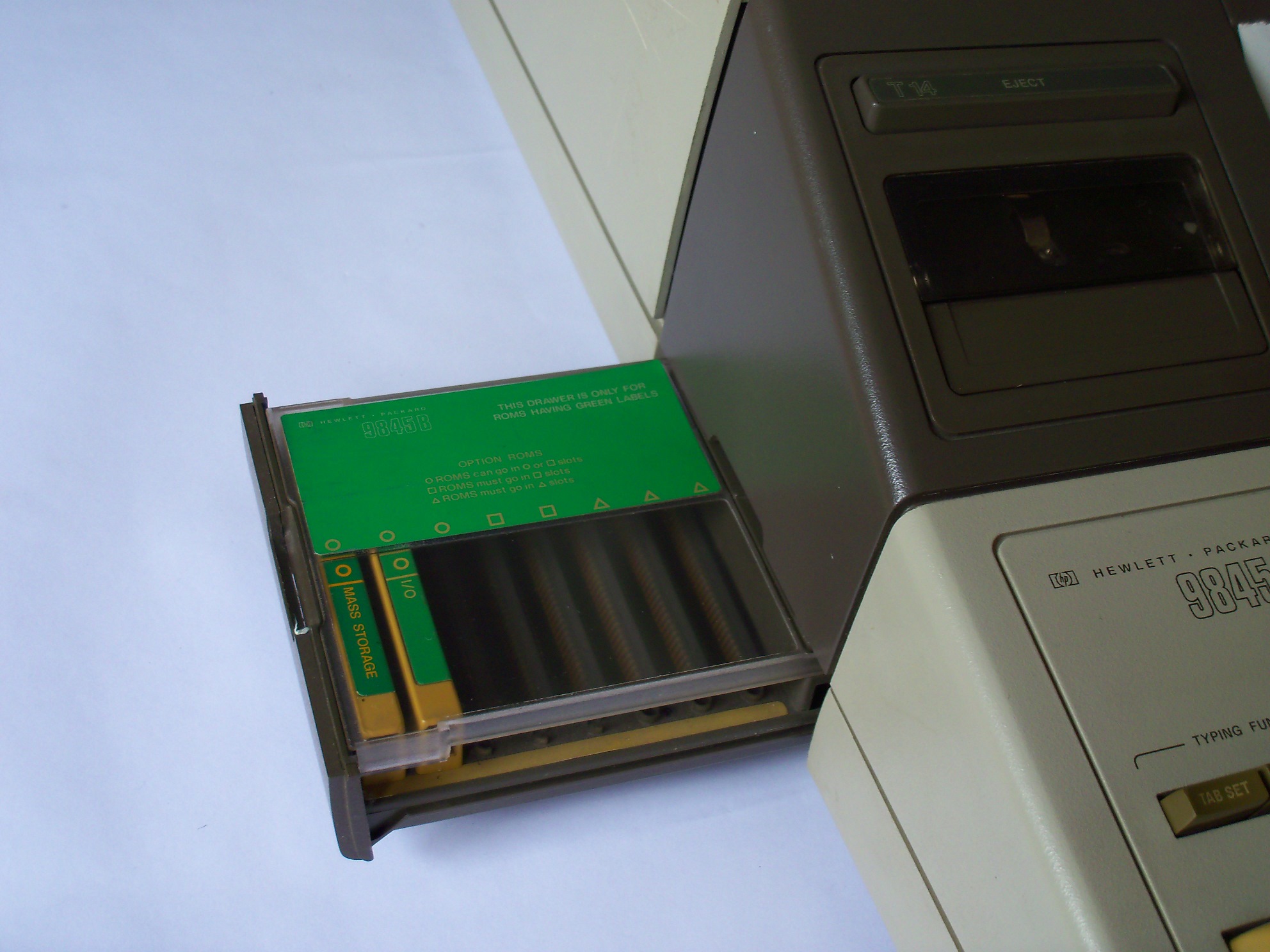 |
Extensions to the operating system firmware was kept for the 9845B in ROM modules, which could be easily installed and exchanged by the user in one of the two ROM drawers. Each of the two CPUs of the 9845 had its own ROM drawer. This one is that of the PPU. The ROM modules are fairly reliable, so one of the most frequent reasons for 9845B systems to hang up during boot - the system ROM failure - normally does not apply to the 9845A, which has all of its system ROMs in pluggable ROM modules. |
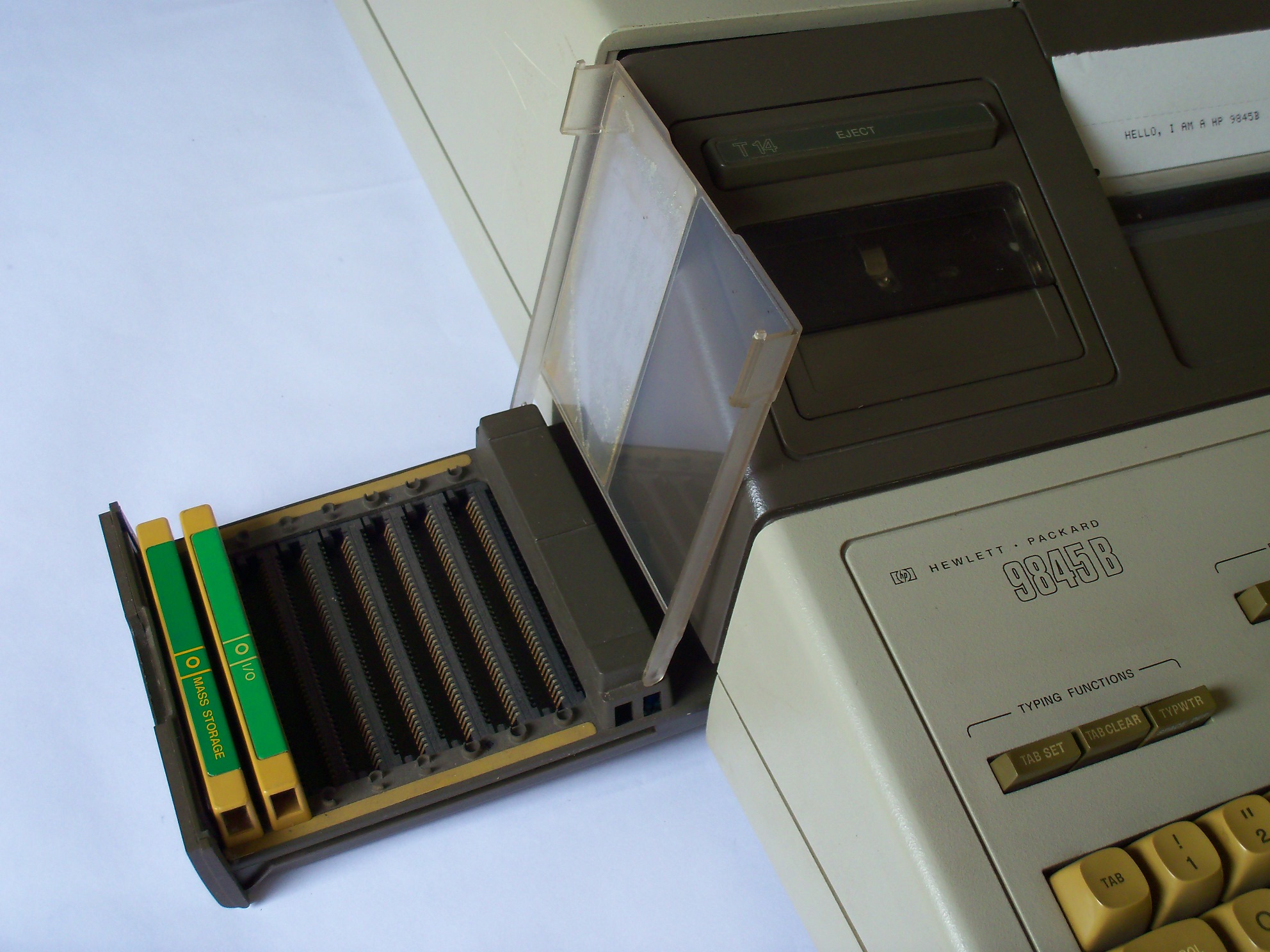 |
Same ROM drawer (PPU), but opened. The PPU ROM drawer is in general populated with at least an I/O option ROM and the Mass Storage option ROM. |
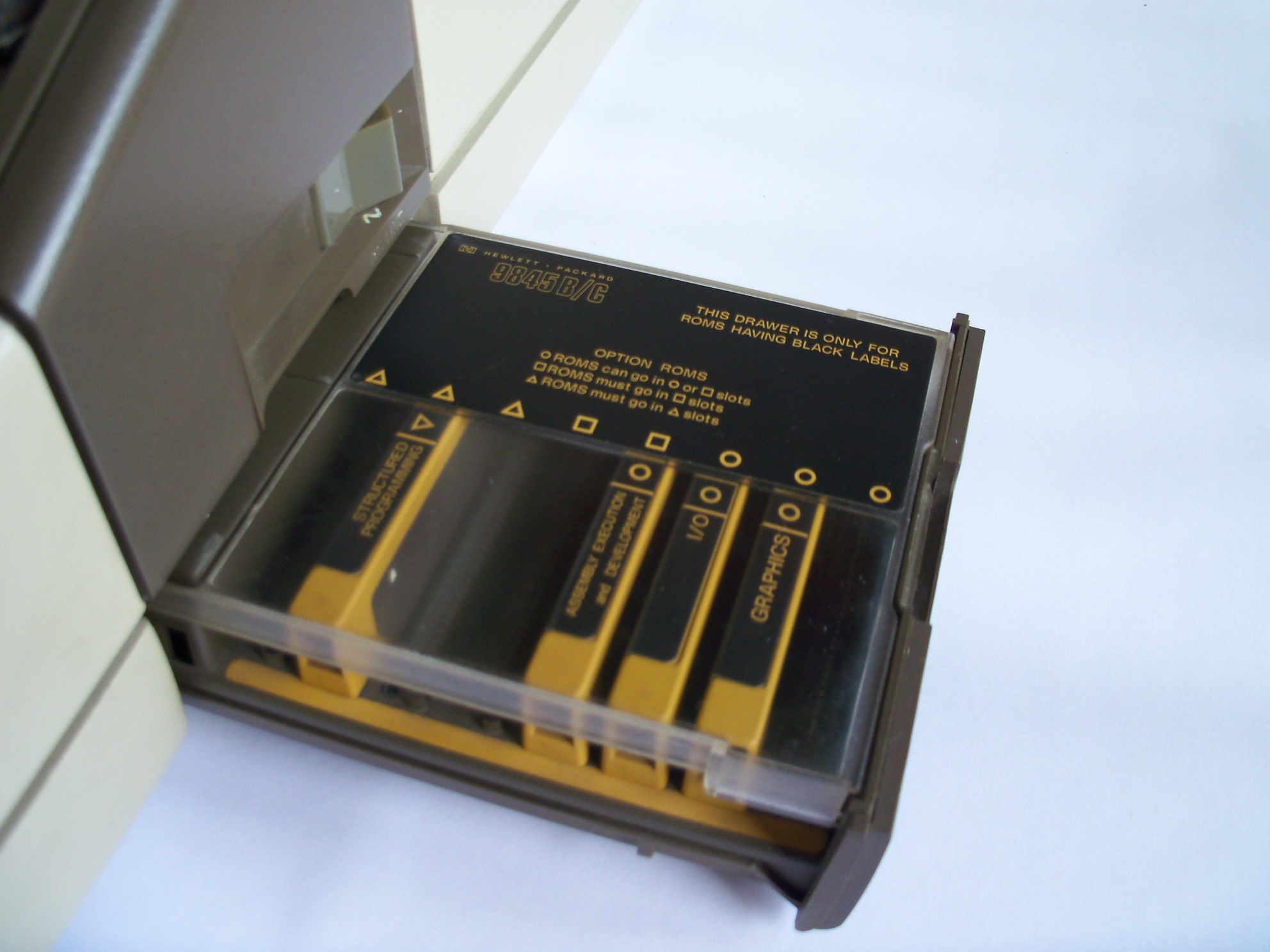 |
The ROM drawer for the LPU processor is on the right side of the system. |
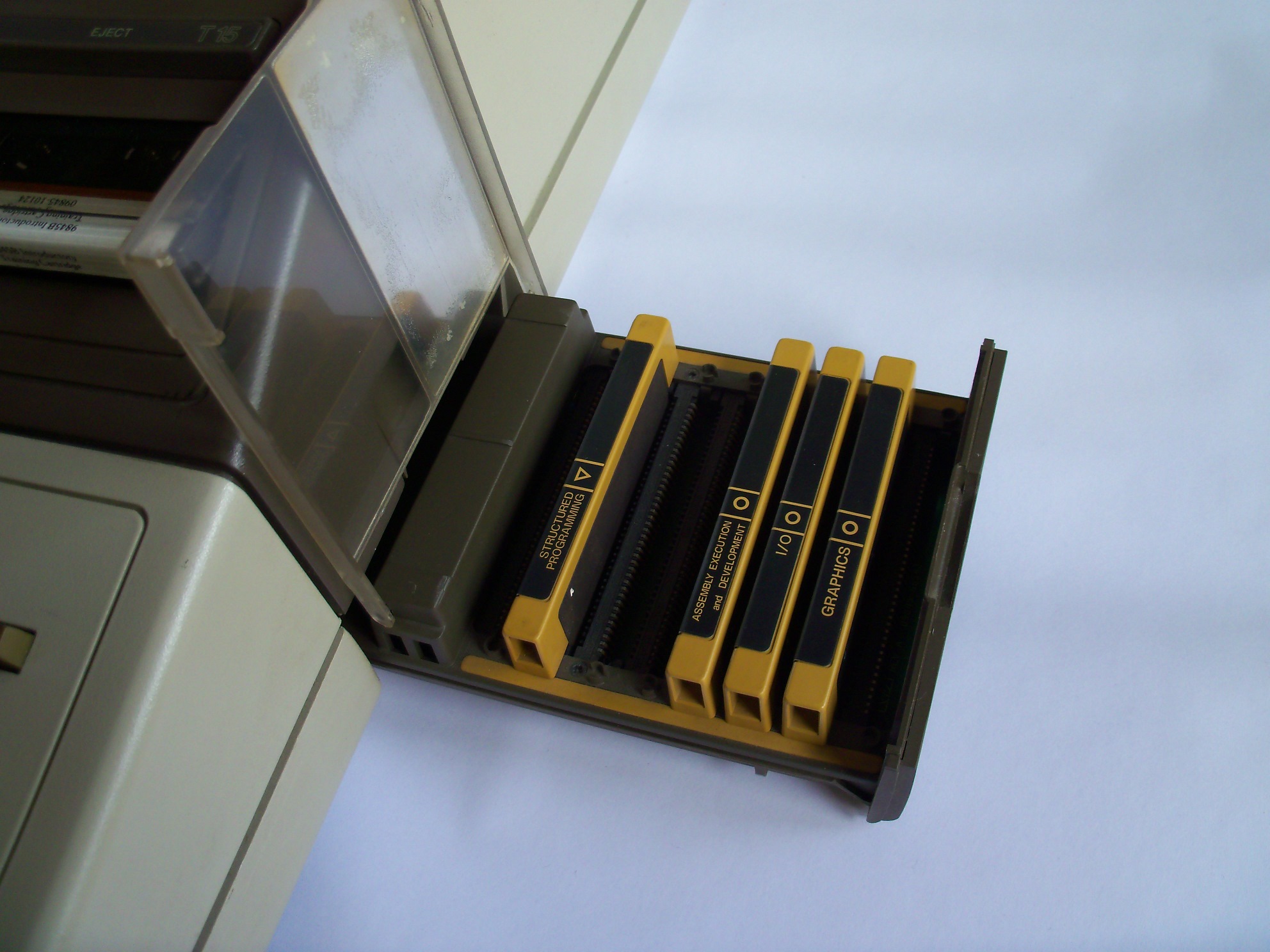 |
Same ROM drawer (LPU), but opened. The LPU ROM drawer is in general populated with at least an I/O Option ROM and - if the graphics option is installed - the Graphics Option ROM. Here also the Structured Programming ROM is installed (which upgrades the standard HP BASIC in a powerful high level programming language similar to Visual Basic) and the Assembly Execution and Development option ROM (which adds interactive Assembly Language development and execution environments). |
 |
9845 BASIC was quite capable, and it was almost impossible to remember all the keywords. So the 9845 provided help cards with quick information overview about all available commands. Also there were listings for all error messages and the most important operations needed to work with a 9845 system (also including the current system configuration). All cards were installed as pull-out cards below the CRT monitor and could easily be accessed each with its own tab. When adding an option ROM for expanding the system firmware, sometimes there were stickers included which could be placed on one of the spare cards. |
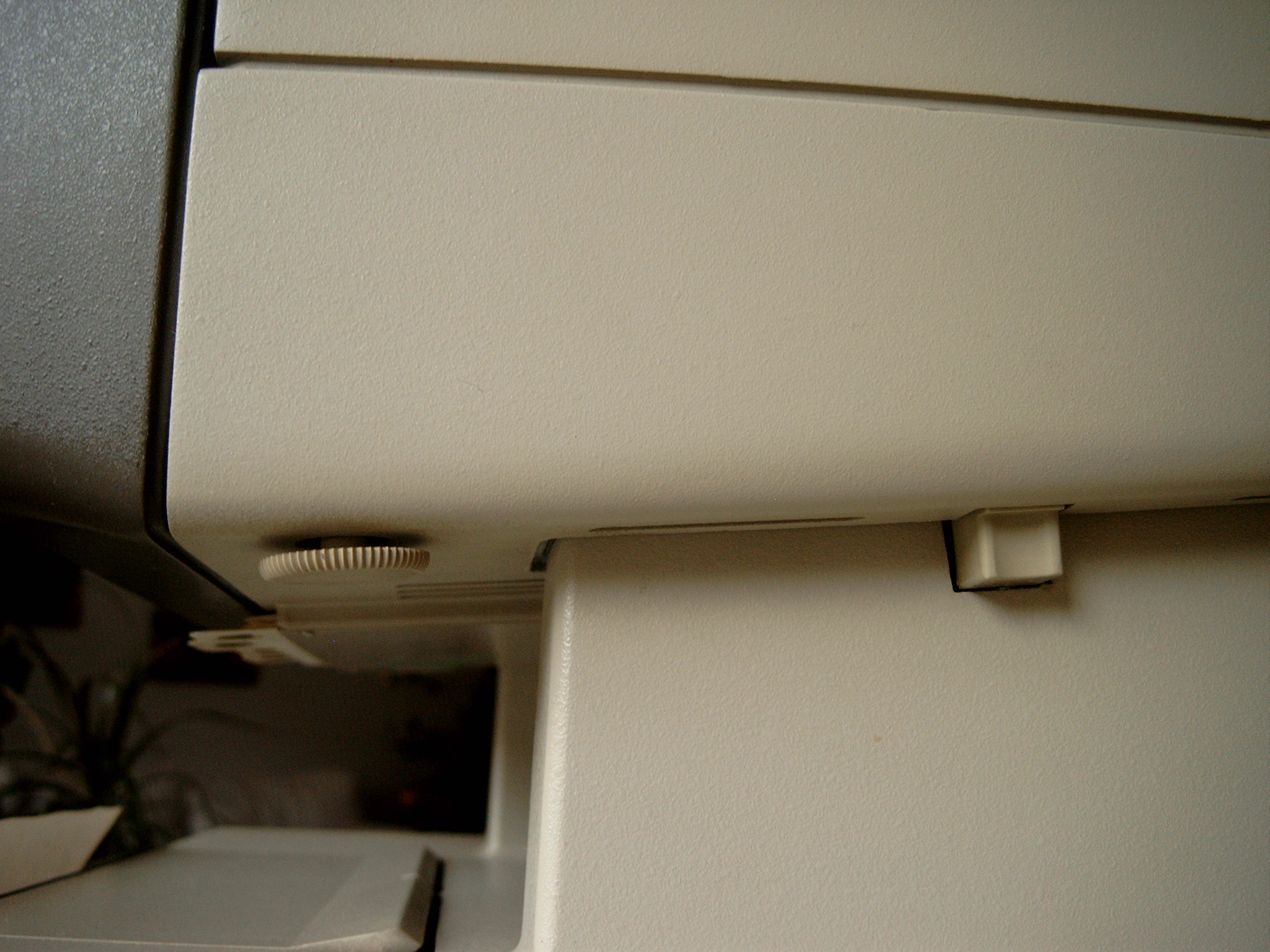 |
The brightness of the CRT monitor display can be adjusted with a small knob on the left below the CRT monitor. If you can't see output on the CRT, the first action should be to turn this control. You also can see the latch for the CRT monitor. There is one latch on each of the legs on which the monitor is mounted. Push in both latches and you can lift up the whole CRT monitor assembly. |
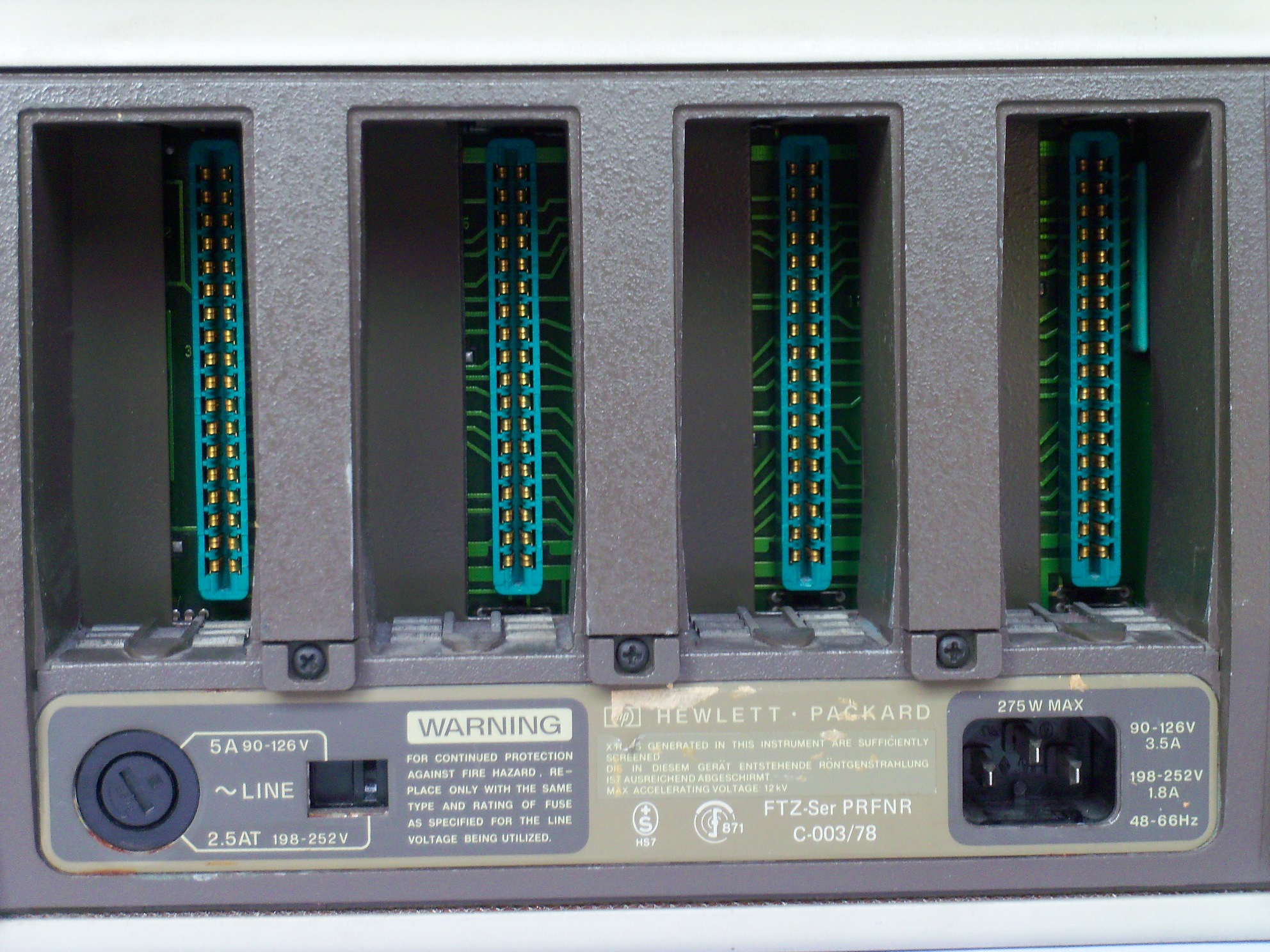 |
Compared to other systems of the time the 9845 had no interfaces to external peripherals. There is almost nothing built-in, no standard parallel or serial port, no joystick port, no external sound. The four connectors in the back of the system each represent a connection to the 9845 I/O bus, and are best comparable to the ISA or PCI expansion slots of common PCs. In order to connect a device (or a network) to it, the appropriate expansion module or "interface" has to be plugged into one of those slots. There were interfaces for almost everything available, including a self-contained real time clock with battery back-up. If four slots are not enough, there is a special bus extender, which provides seven I/O slots in a separate break-out box. |
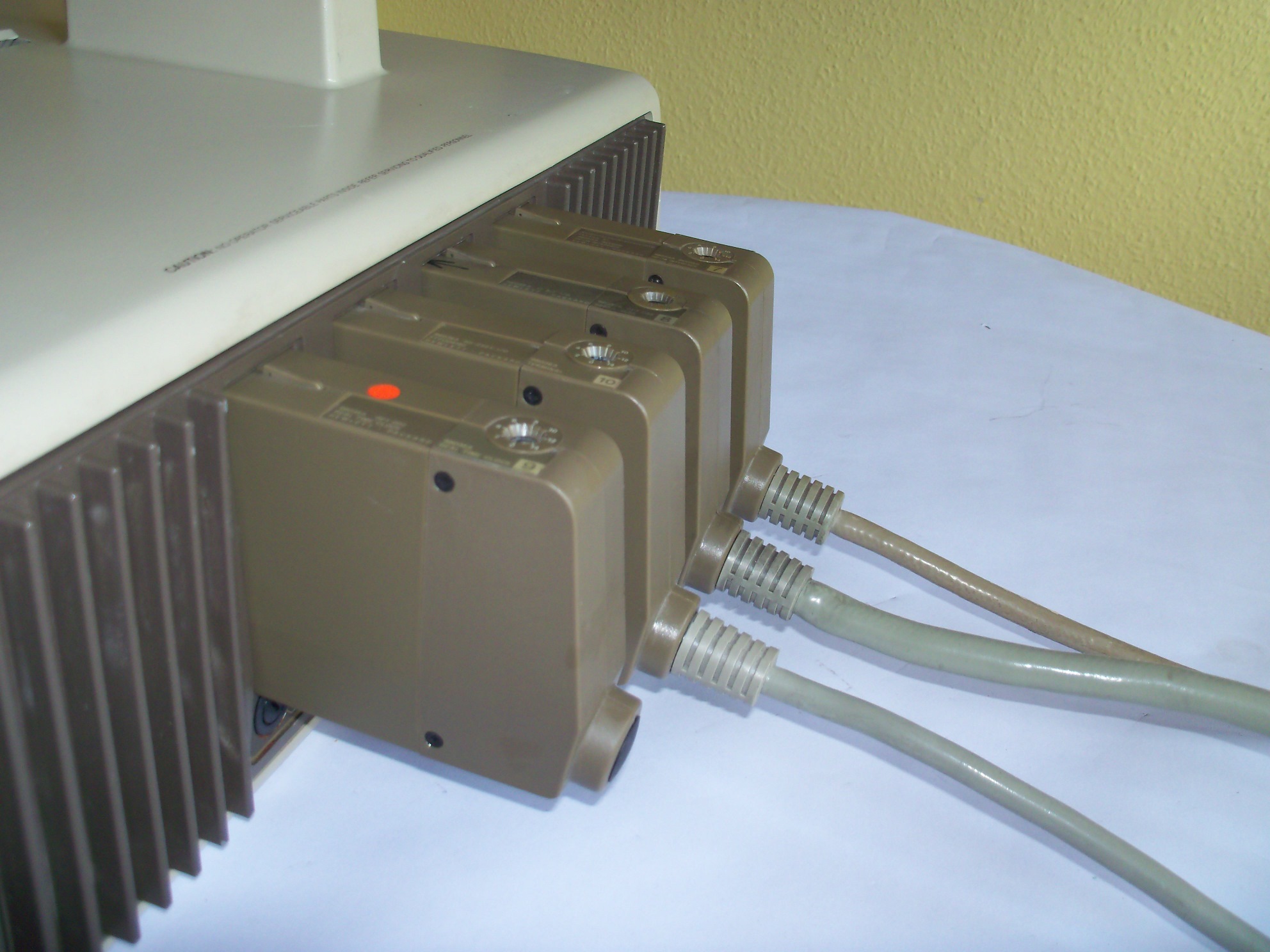 |
HP 9845 interfaces in general look much like cables with big plugs. In fact the "plug" holds all the electronics, which is needed to interface to the device at the other end of the cable. Compared to a standard PC, the HP 9845 interfaces are essentially expansion boards which are plugged from outside to the computer case instead of being installed inside the system. All 9845 models support all interfaces. In general, those interfaces are also compatible with the HP 9825 (most were in fact originally developed for the 9825). |
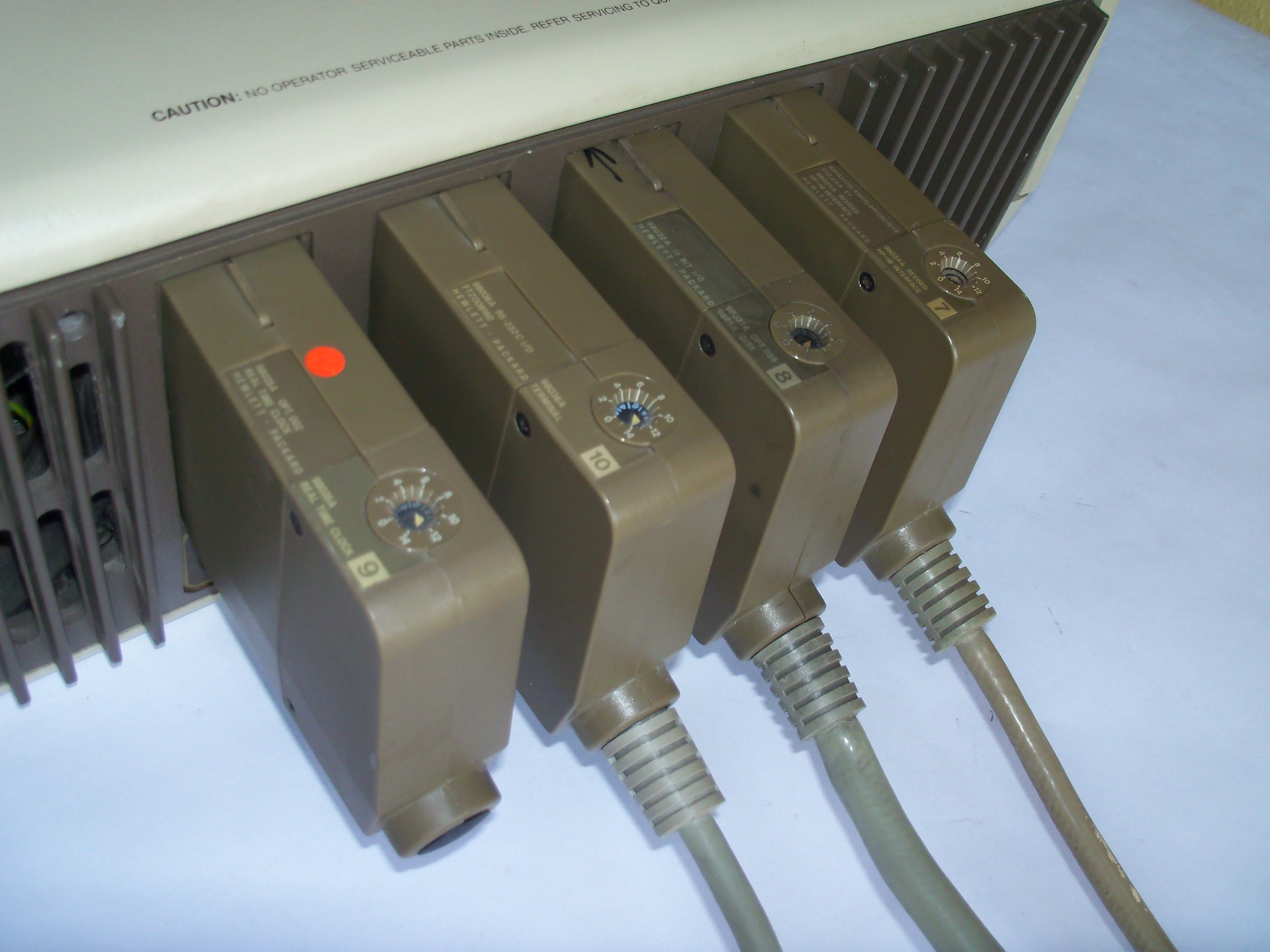 |
Here a number of the most common interfaces is plugged into the I/O slots. Form left to right: 98035A Real Time Clock |
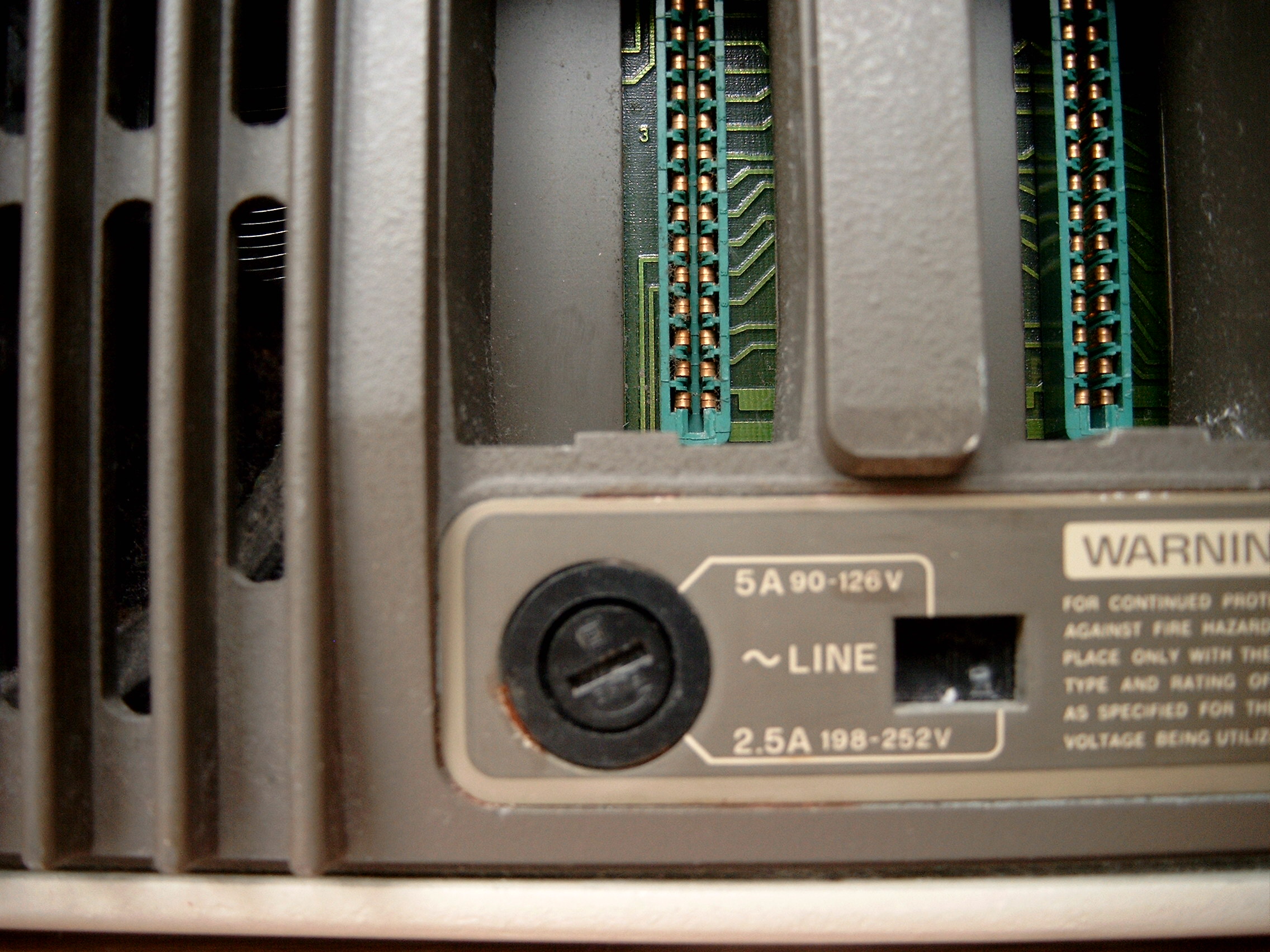 |
The 9845 could be operated with both 110V/60Hz and 220V/50Hz AC. However it did not have a voltage auto-detect like modern switching PSU have, so it is essential to check and configure the 9845 to the right setting before connecting it to a power line. If nothing happens when switching on a 9845 (even fans not spinning) probably the fuse has to be exchanged. But consider that there might be a reason why the fuse has blown before, which can indicated it is not safe to power on the system because the reason (e.g. a short circuit) is still there. |
The 9845 uses a standard power cord to connect to the AC power source. Power consumption is 275 Watts maximum. The power jack is part of a line filter module which is placed directly behind the rear cover. |
|
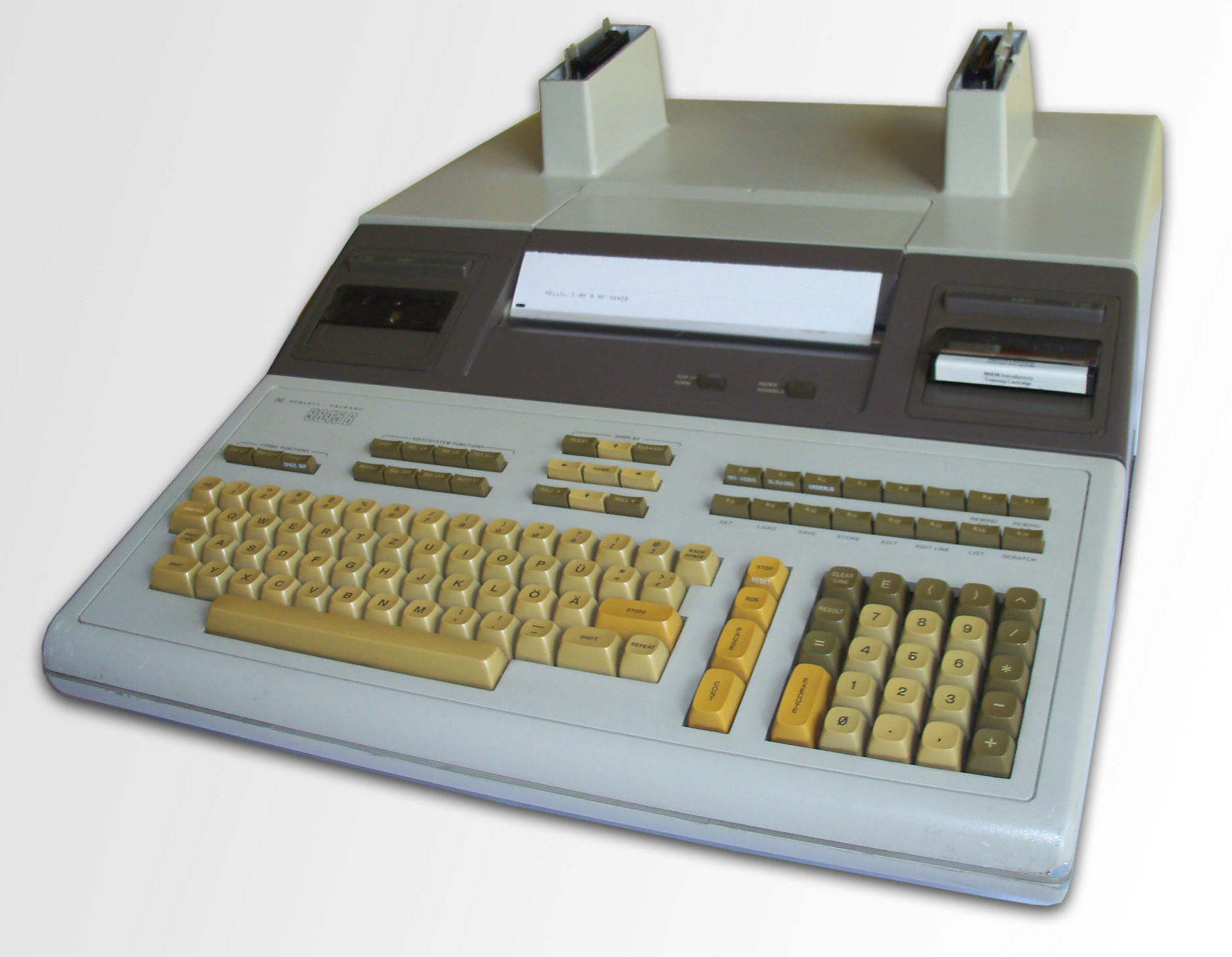 |
The system without the CRT monitor is also called the "mainframe". It includes (in a highly packed way) the core components (PSU, mainboard, CPUs, memory, display logic, keyboard) and a couple of useful peripherals (thermal printer, cartridge tape drives). The whole system may appear somewhat bulky, at least compared to other desktop systems, however one have to keep in mind that a complete printer subsystem is included.
|
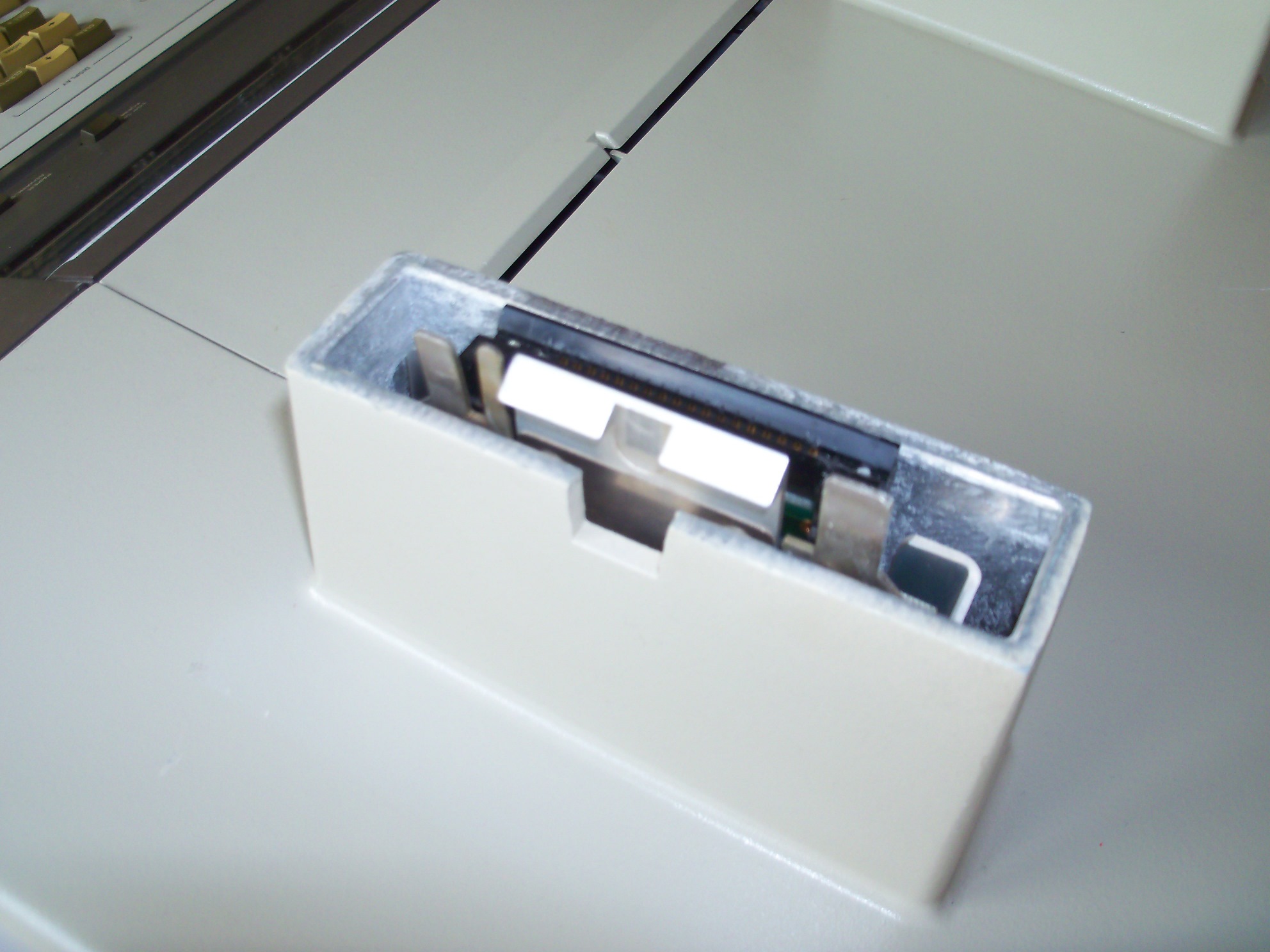 |
The CRT display is a complete unit, but is not connected by a cable to the main system, but rather via connectors integrated into the two CRT monitor "legs". This is necessary, because the HP 9845 has an "intelligent" CRT display, which means that parts of the alpha controller and the whole graphics subsystem is inside the CRT unit. Therefore lot more signals have to be provided to the CRT than just an RGB signal. Which again means, that the CRT unit is fixed mounted and can't be adjusted to other angles of view. |
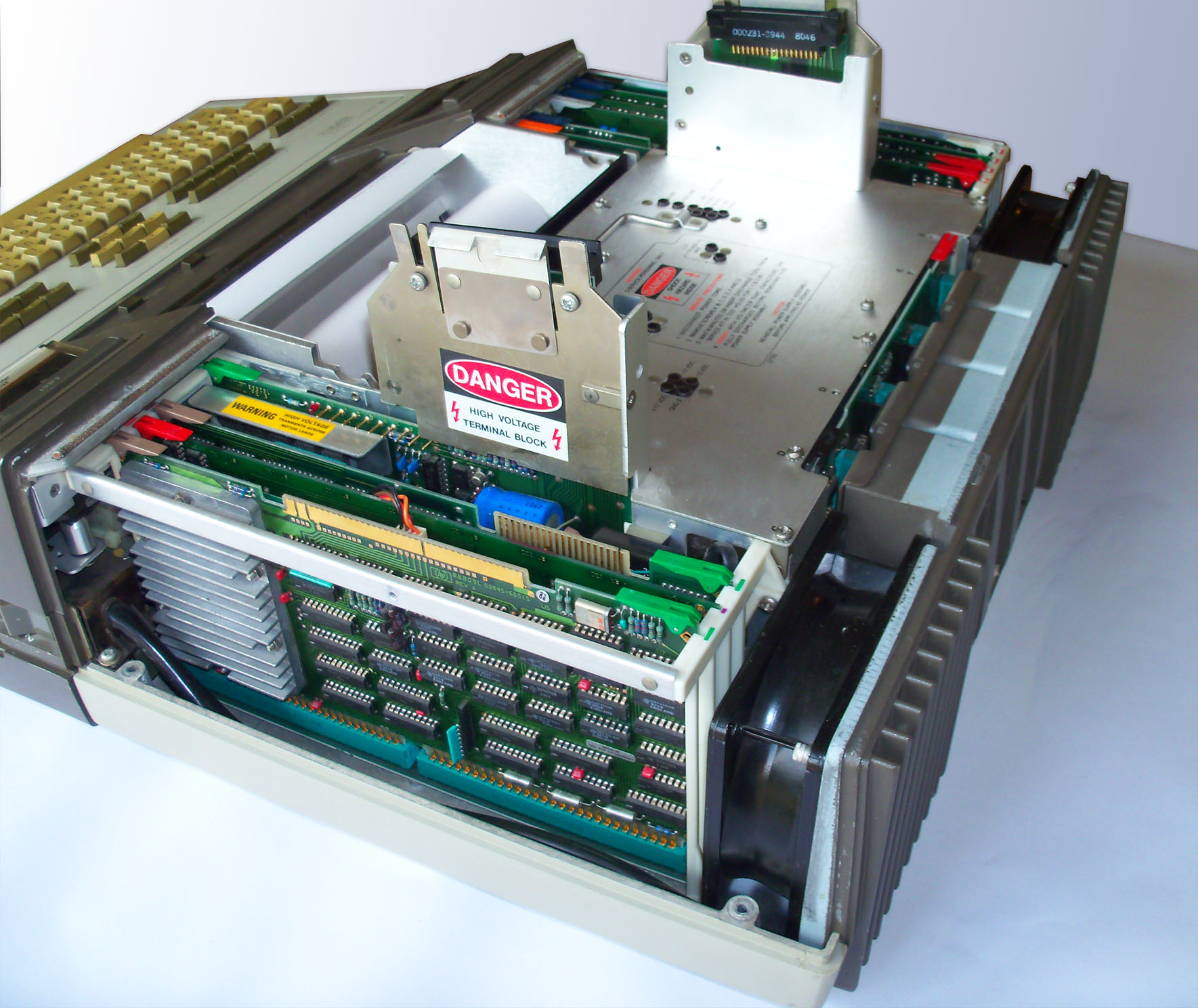 |
Here the 9845B mainframe is shown with also the top cover removed. You can see the board with the LPU with its heat sinks, and the fan on the right which draws the air over the CPUs out of the system.
In the middle is the PSU with its aluminium plate, framed by the CRT monitor legs, the I/O backplane and the printer. All mainframe boards plug into edge connector slots in mainboard, which is mounted on the system's floor. |
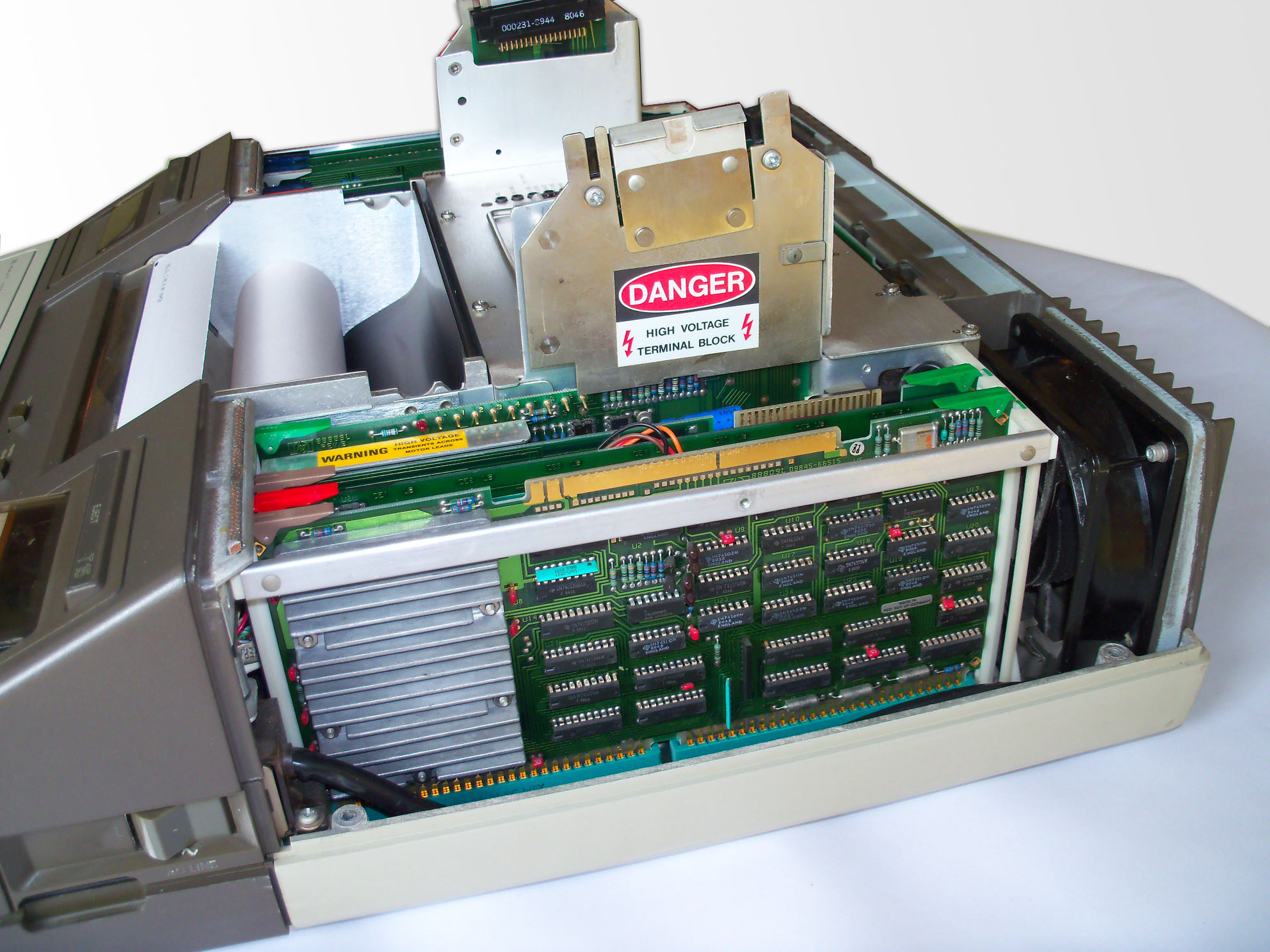 |
View of the LPU processor assembly, installed in the right card cage. Note the large "honda head" heat sink which dissipates the heat from the processor. The fan behinf draws the air out of the back of the system, so there is an air channel which guides the cooling air over through the whole card cage (including the processors). |
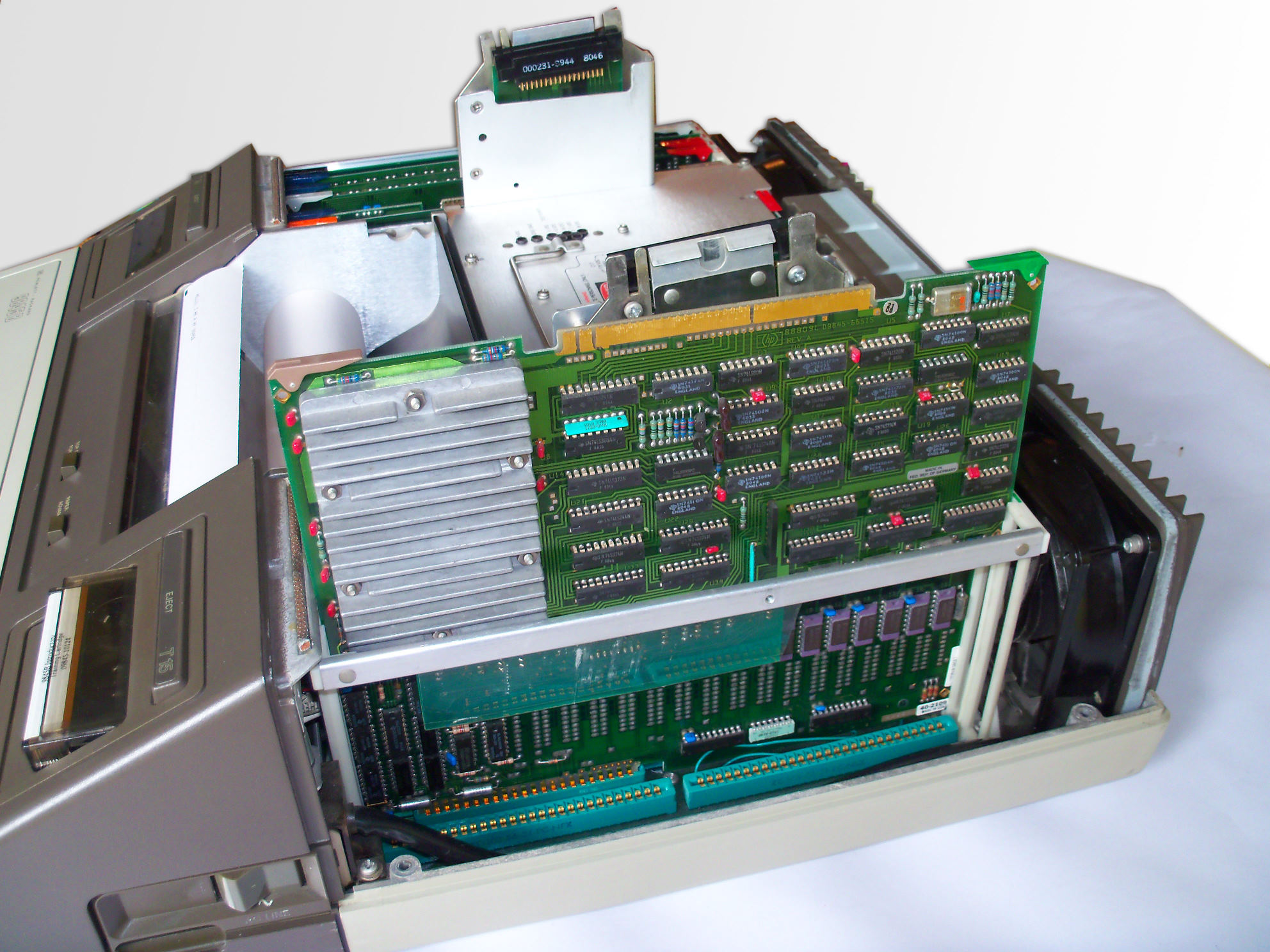 |
Note that each board is equipped with a pair of levers for extracting the boards from their slots. Also those levers denote with a color code on the PCB guidance which board has to be placed in which slot. Although extracting gets easier with those levers, it is not recommended to use them, since they have lost their stability during the years and quickly brake off. Better try to move the boards by grabbing the board's PCB. The board half extracted from the cage is the memory address extension board, which allows the 9845B processors to address more than one 64 kByte memory block. |
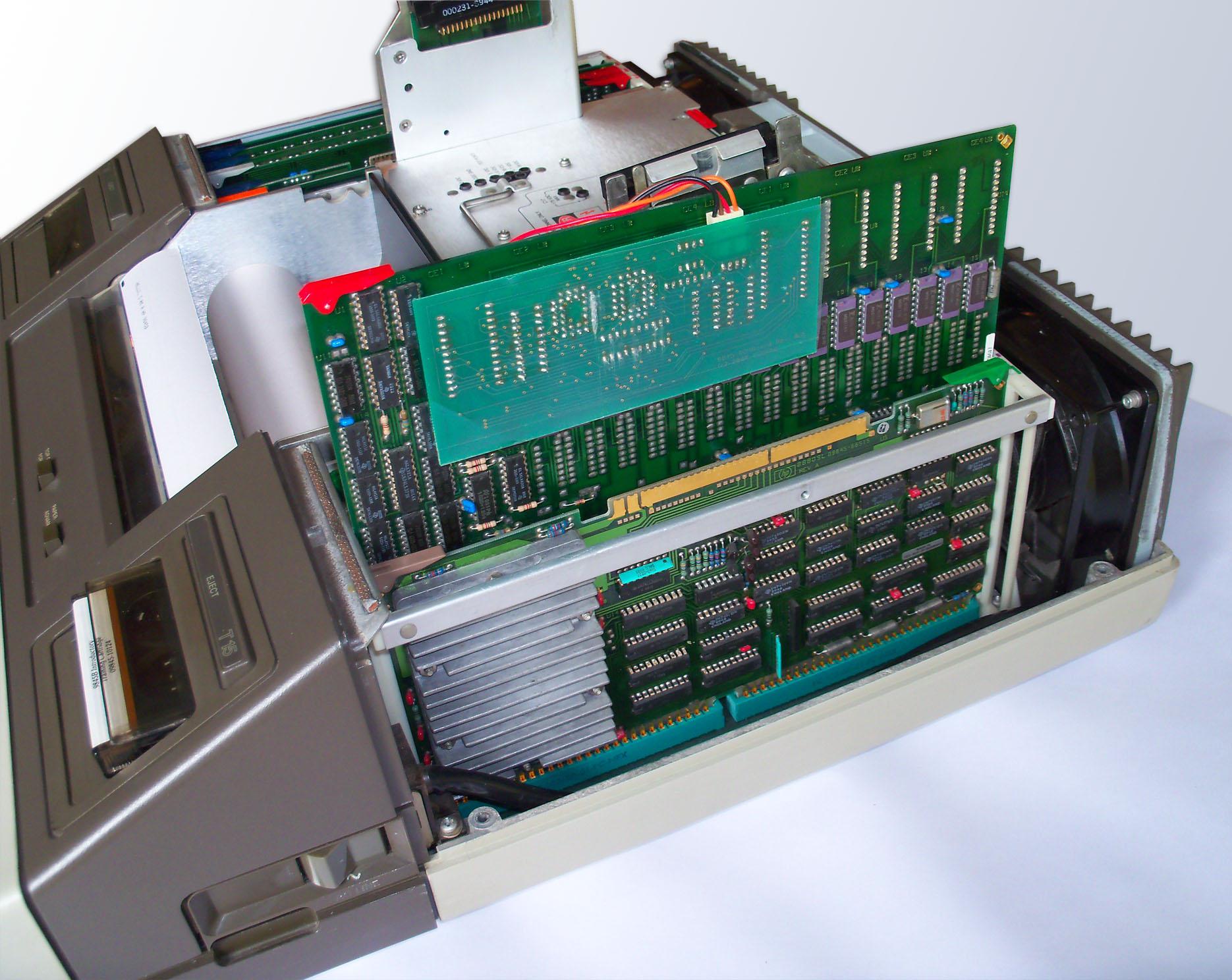 |
Next to the LPU board there is the PPU RAM/ROM assembly. Note that here the ROM board is installed as a piggy-back PCB on the RAM/ROM assembly, replacing the original PPU ROMs which have gone defect. The PPU RAM/ROM board holds 128 kBytes of ROM and 32 kBytes of RAM (half a memory block). The PPU RAM also functions as a character buffer for the CRT display. |
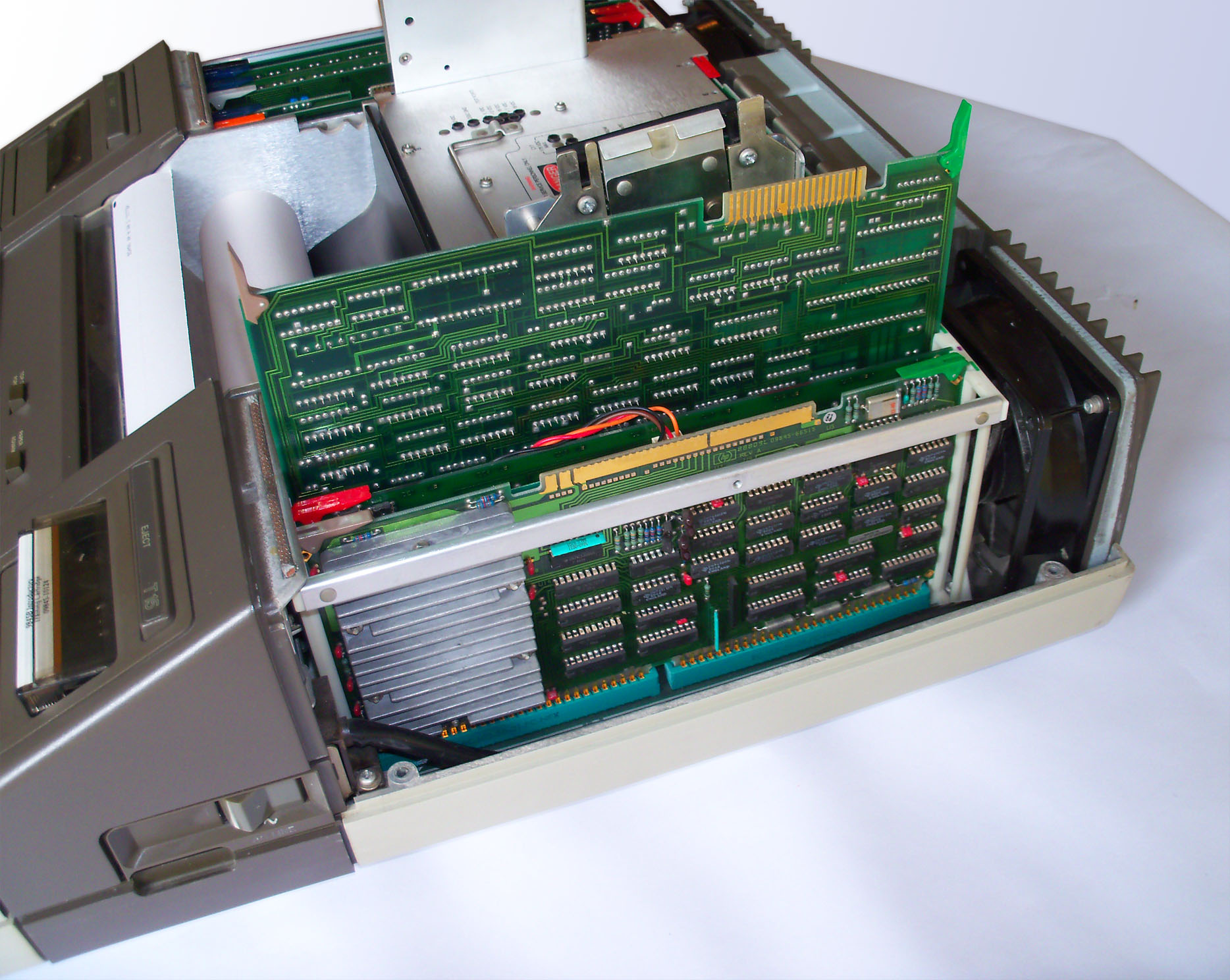 |
Behind the RAM/ROM board there is the printer control assembly, which holds the logic for the internal printer. In fact, the board is a complete computer on its own, with RAM, ROM and a microprocessor (HP's own "nanoprocessor") on it. |
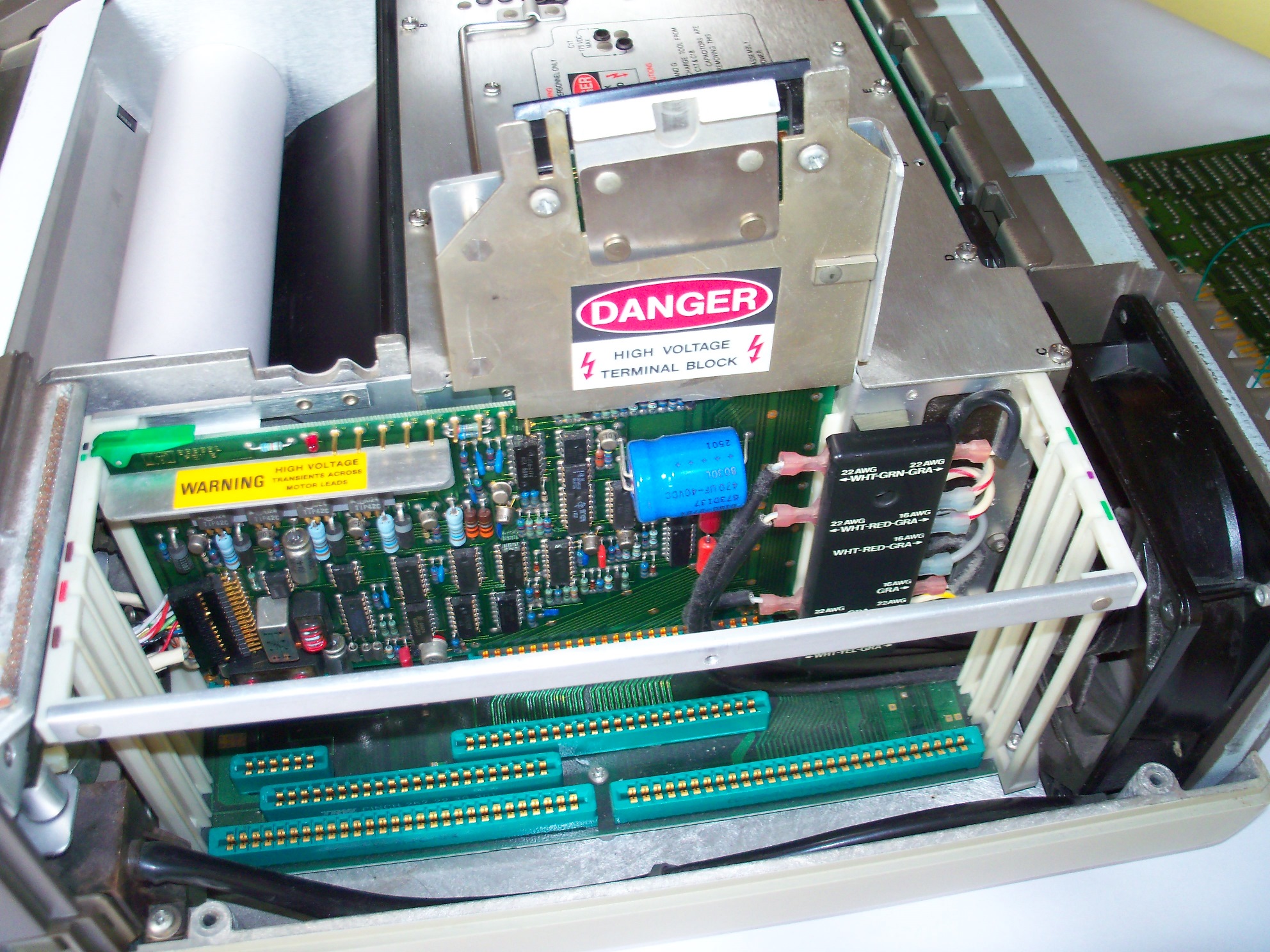 |
Last there is the CRT connector board installed in the card cage, which also holds the driver circuits for the internal thermal printer. |
 |
The internal printer is a larger unit, which takes some space inside the 9845 mainframe. However compared to external printers, it has an overall compact design to fit inside the system. Note the paper roller, which moves the paper. The roller itself is driven by a stepper motor over a drive belt. |
 |
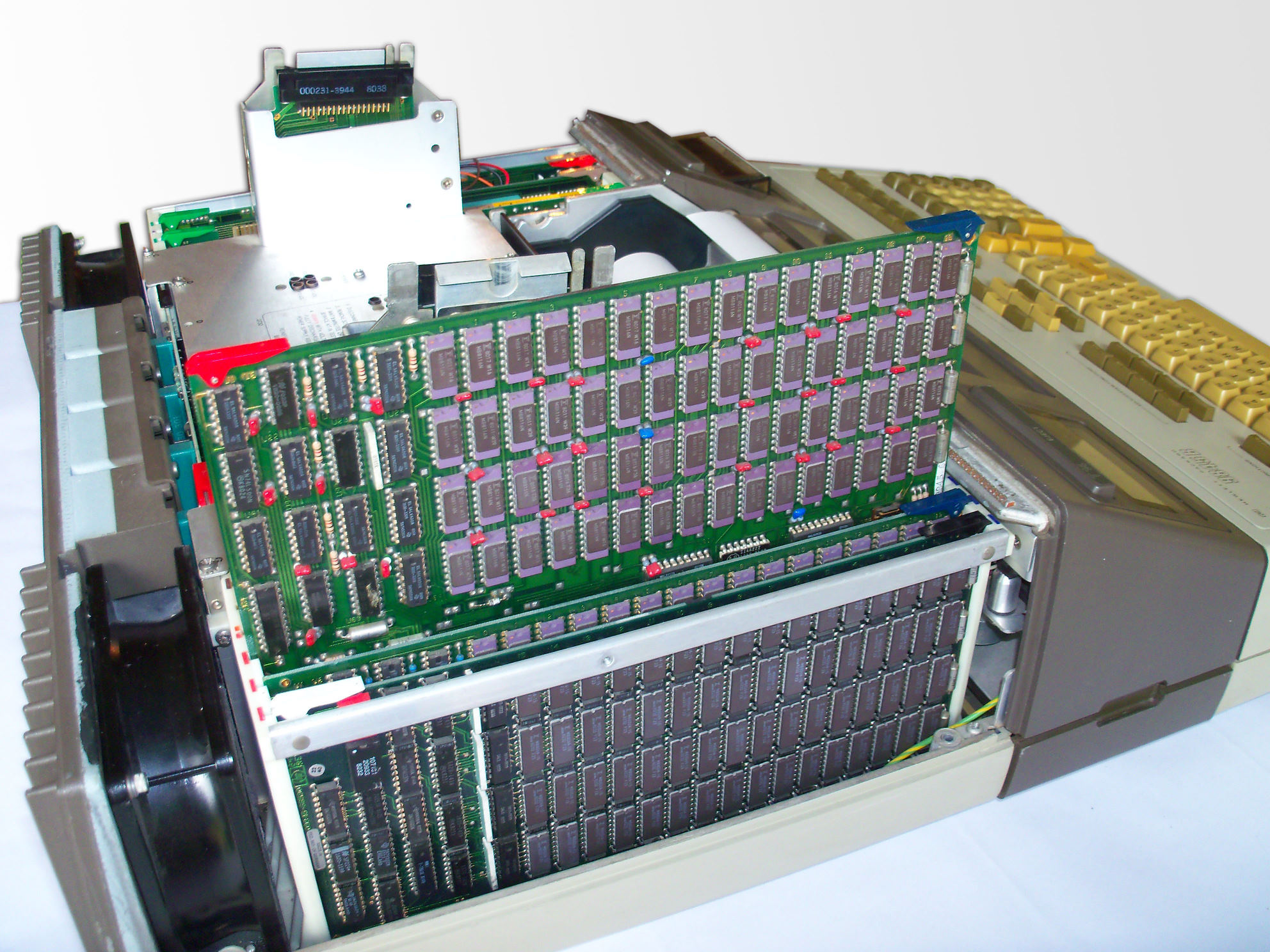
Top view of the left (memory) board cage. |
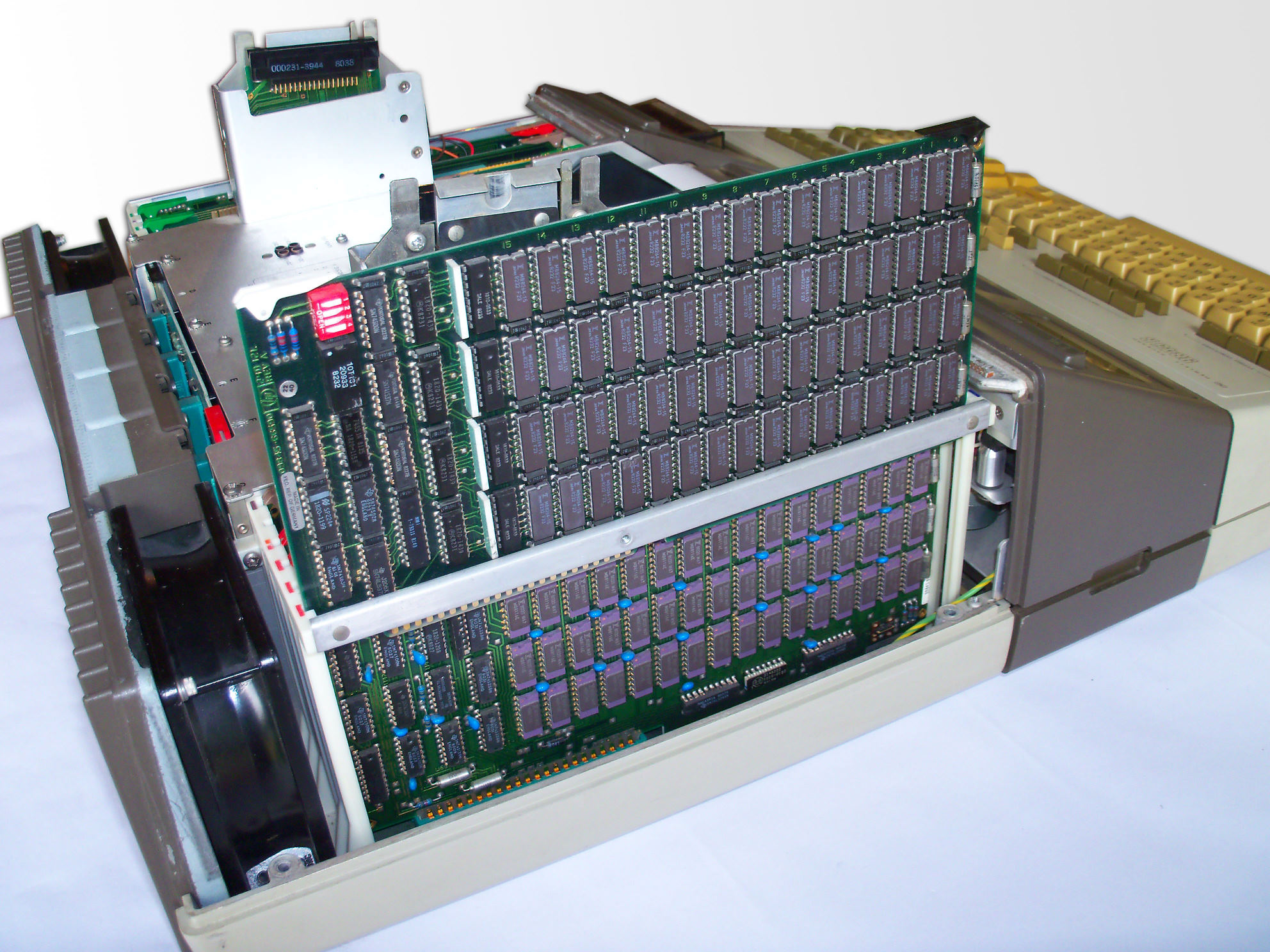 |
The assembly which is pulled up is a 512k memory board, which is the largest memory assembly for the HP 9845. It works with both HP 9845B and HP 9845C, however needs a special ROM set in order to make the additional RAM space available for all software. Up to three of these boards can be installed, providing the HP 9845 with 1.5 MBytes of memory - an incredible amount of RAM at a time, when the IBM PC was not yet invented on which Bill Gates once stated "no one will ever need more than 640 kBytes"... |
 |
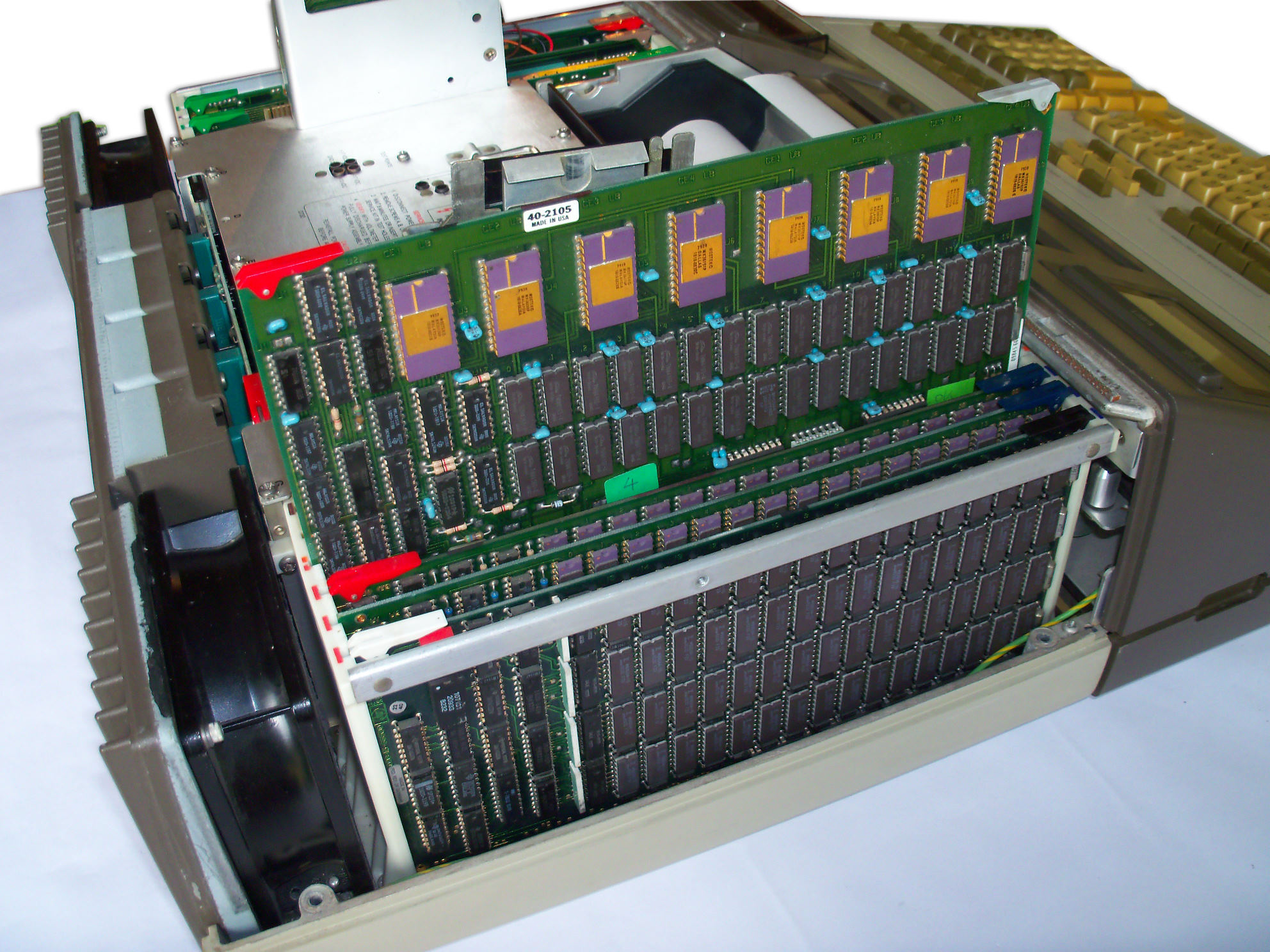
For comparison, here the standard RAM assembly is pulled out, which provides 128 kBytes of RAM. |
 |
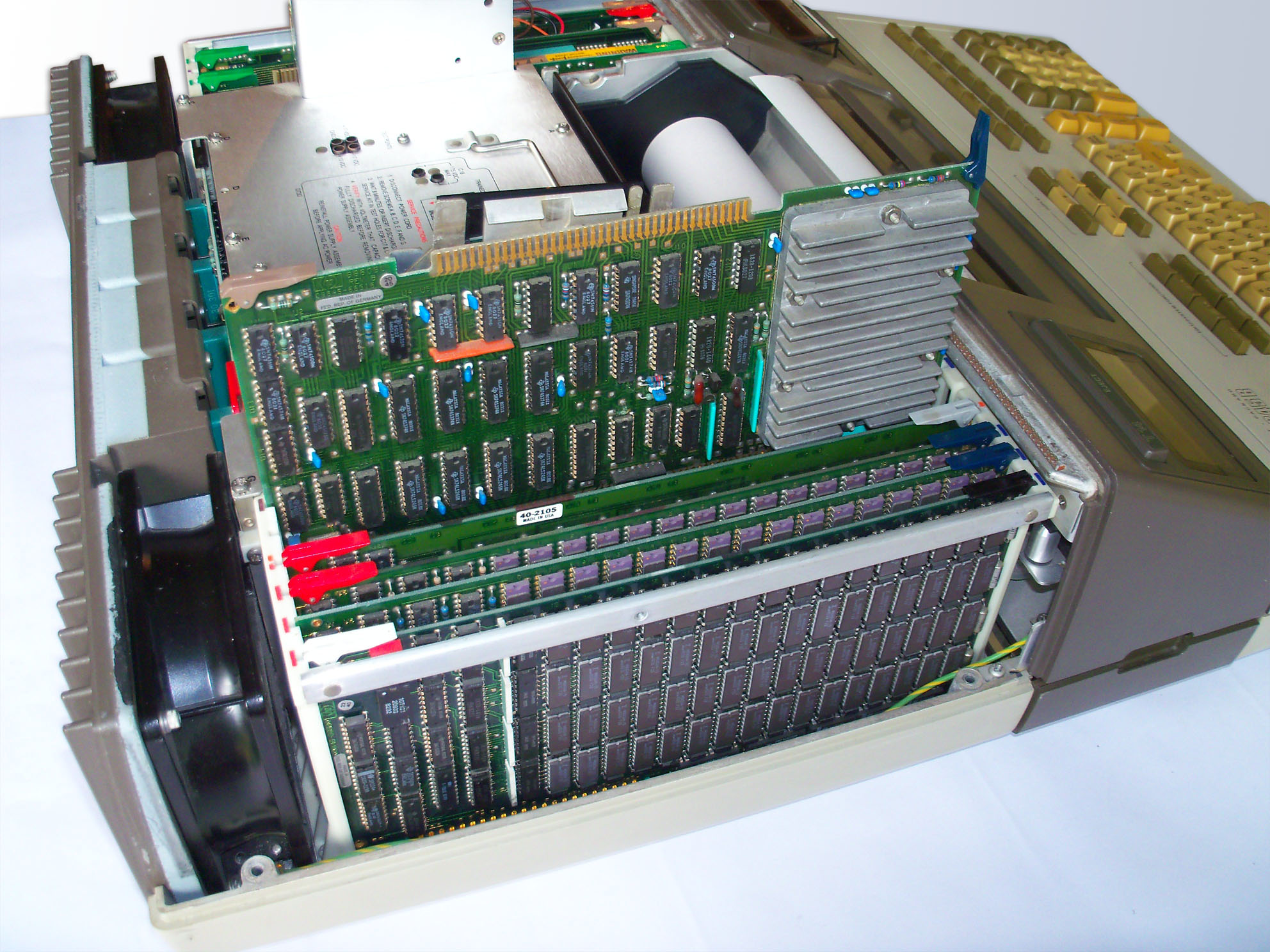
This picture shows the RAM/ROM assembly for the LPU (which is actually installed on the other side of the PSU). The LPU RAM/ROM assembly holds 128 kBytes of ROM and 64 kBytes of RAM (one full memory block). |
 |
Here the PPU is pulled out of the cage. Note again the "honda head" like heat sink. On the side there is an edge test connector. On the lower side, the PPU assembly connects to both the memory and the I/O bus. |
 |
With all cards removed from the card cage, the alpha control assembly gets visible. It holds all electronics for reading the display buffer in the PPU memory block, for working the display list stored in that buffer, and for sending a character stream to the CRT display. Note that the board is partly hidden behind an aluminium plate which secures the left CRT display leg. Also note the two edge connectors on the botton, which connect the PPU board to the PPU's memory bus and the system I/O bus. |
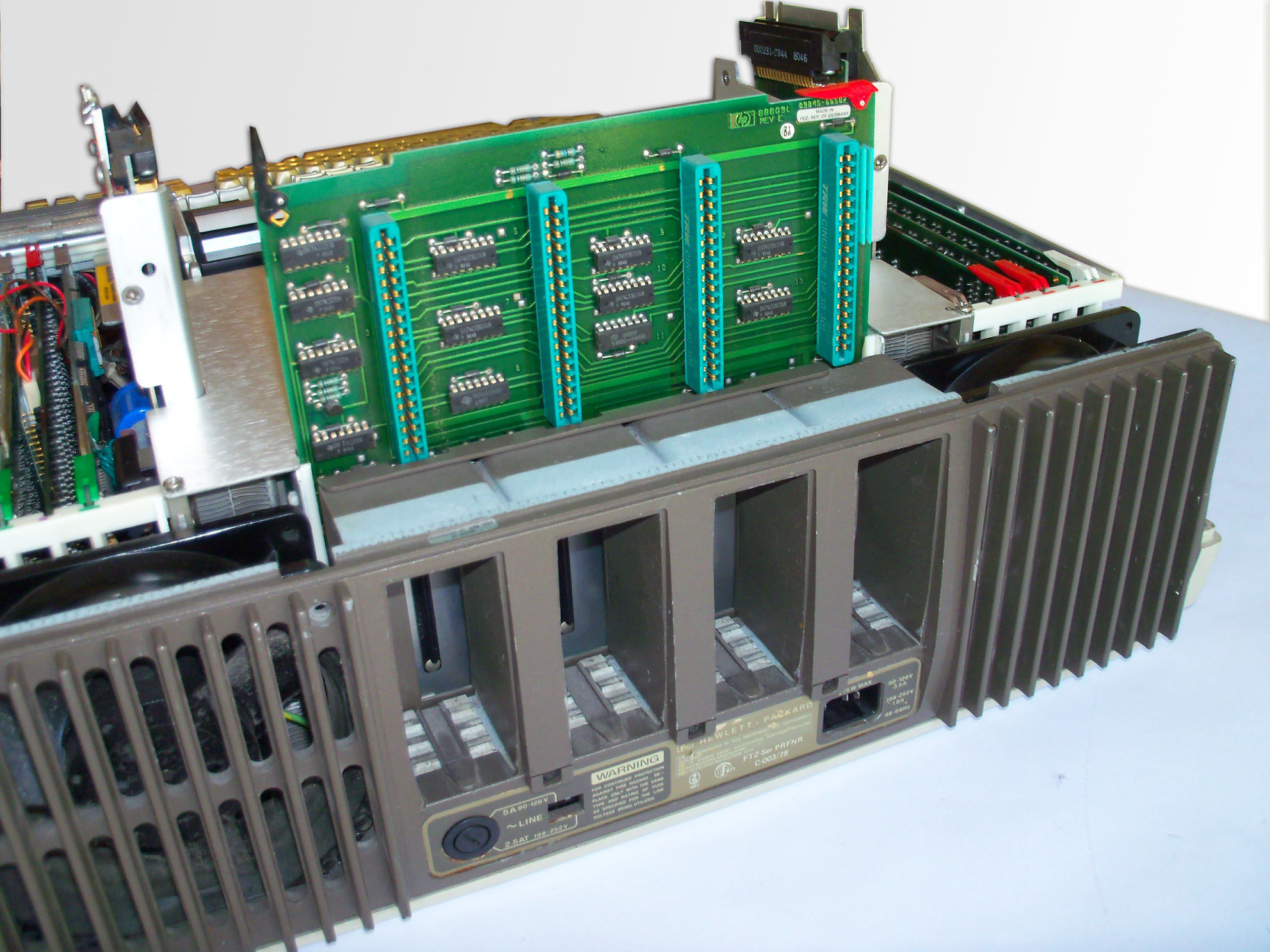 |
The backplane (here almost drawn outside the mainframe) holds the four I/O connectors, which are implemented as edge connectors. The backplane connects to the system I/O bus (the IOD bus) via another edge connector on the mainboard below. |
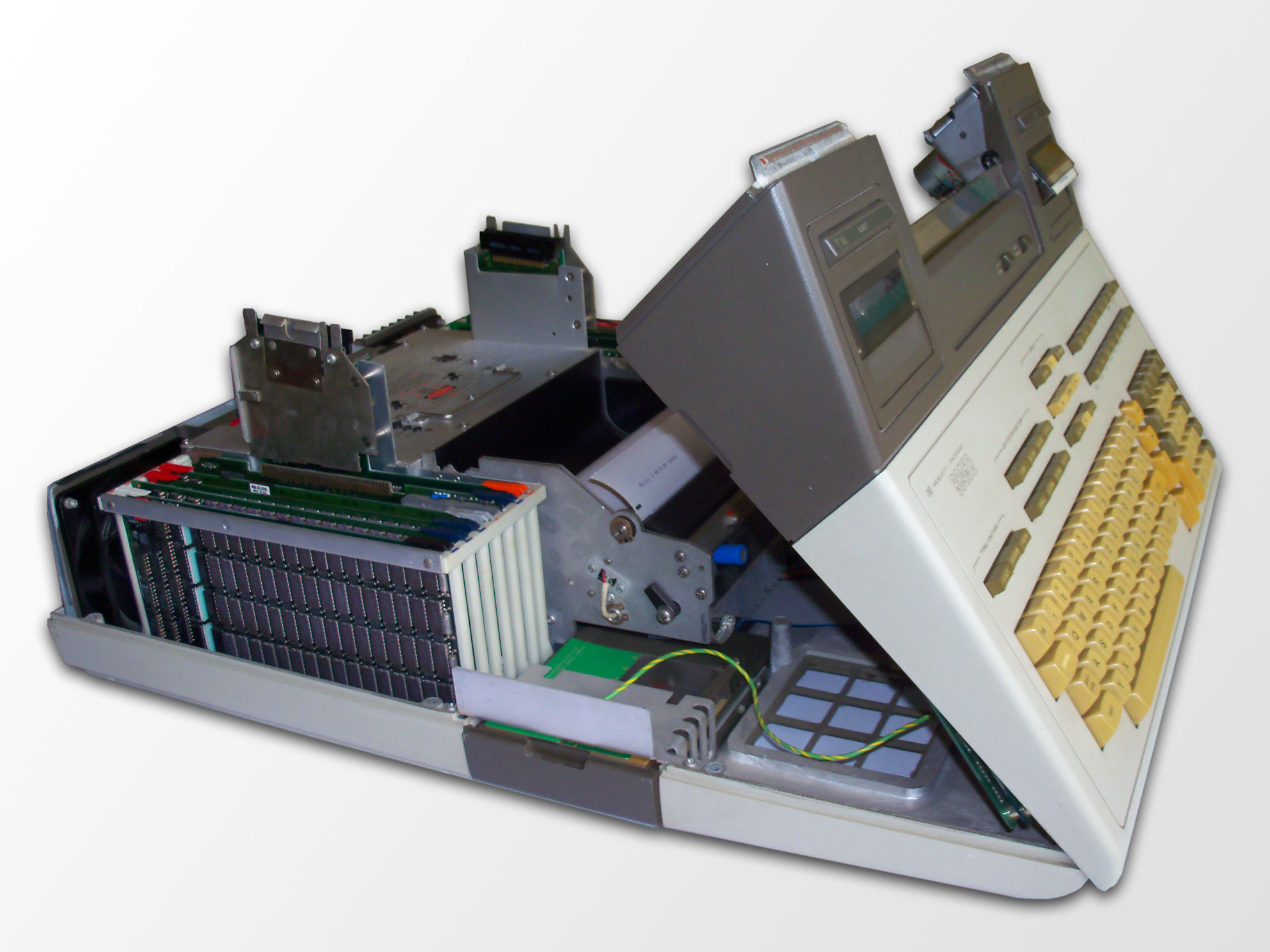 |
The 9845 was a wonder of micro electronics. Probably is was the highest integrated system at the time. Nevertheless, the system design is totally modular and service friendly. Everything was within reach with only a few movements. The system could be operated and tested when opened. |
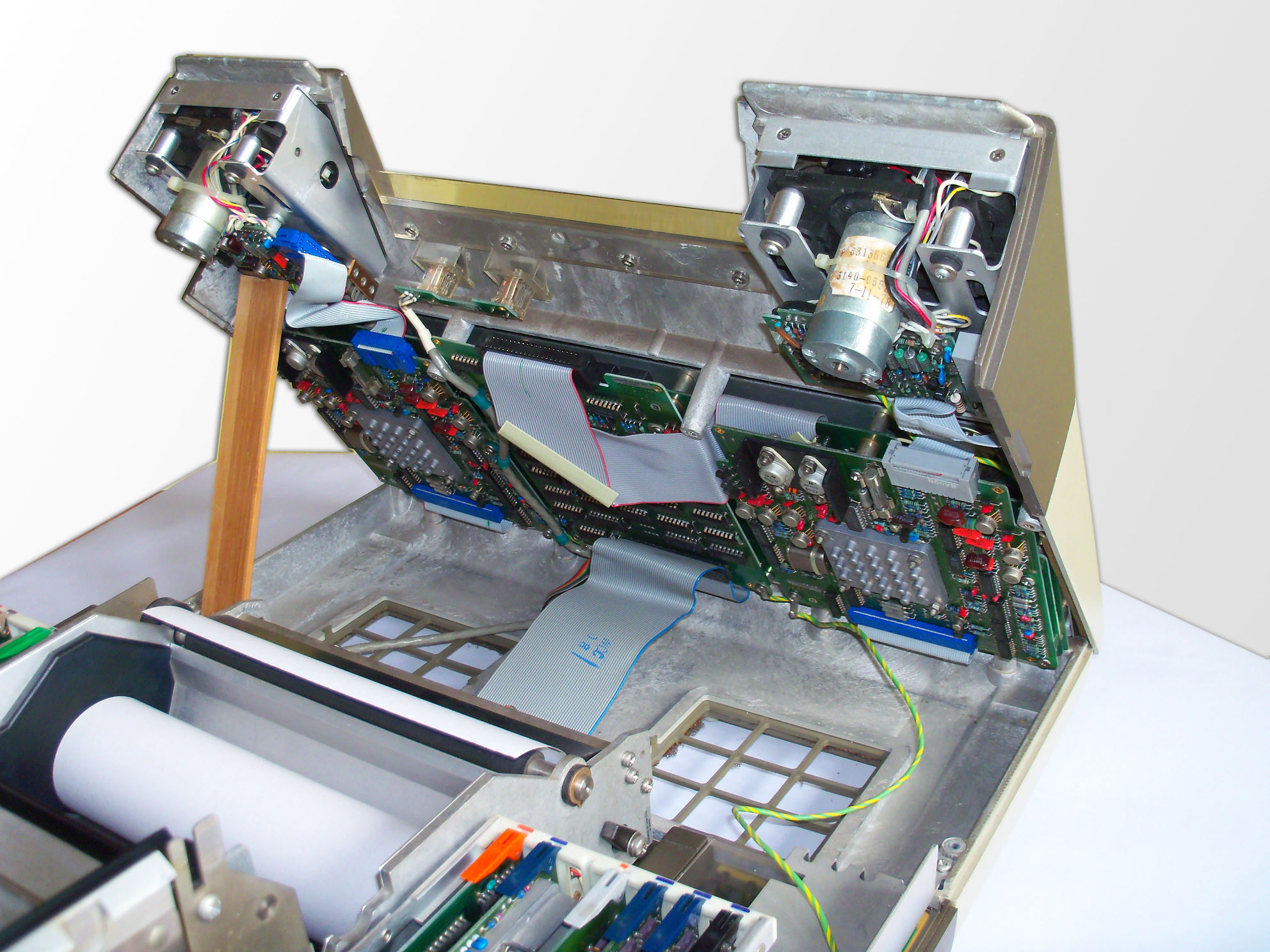 |
Keyboard and tape cartridge drives build a unit, which is connected to the remaining system by a single ribbon cable. It can be raised so that all assemblies are within reach. |
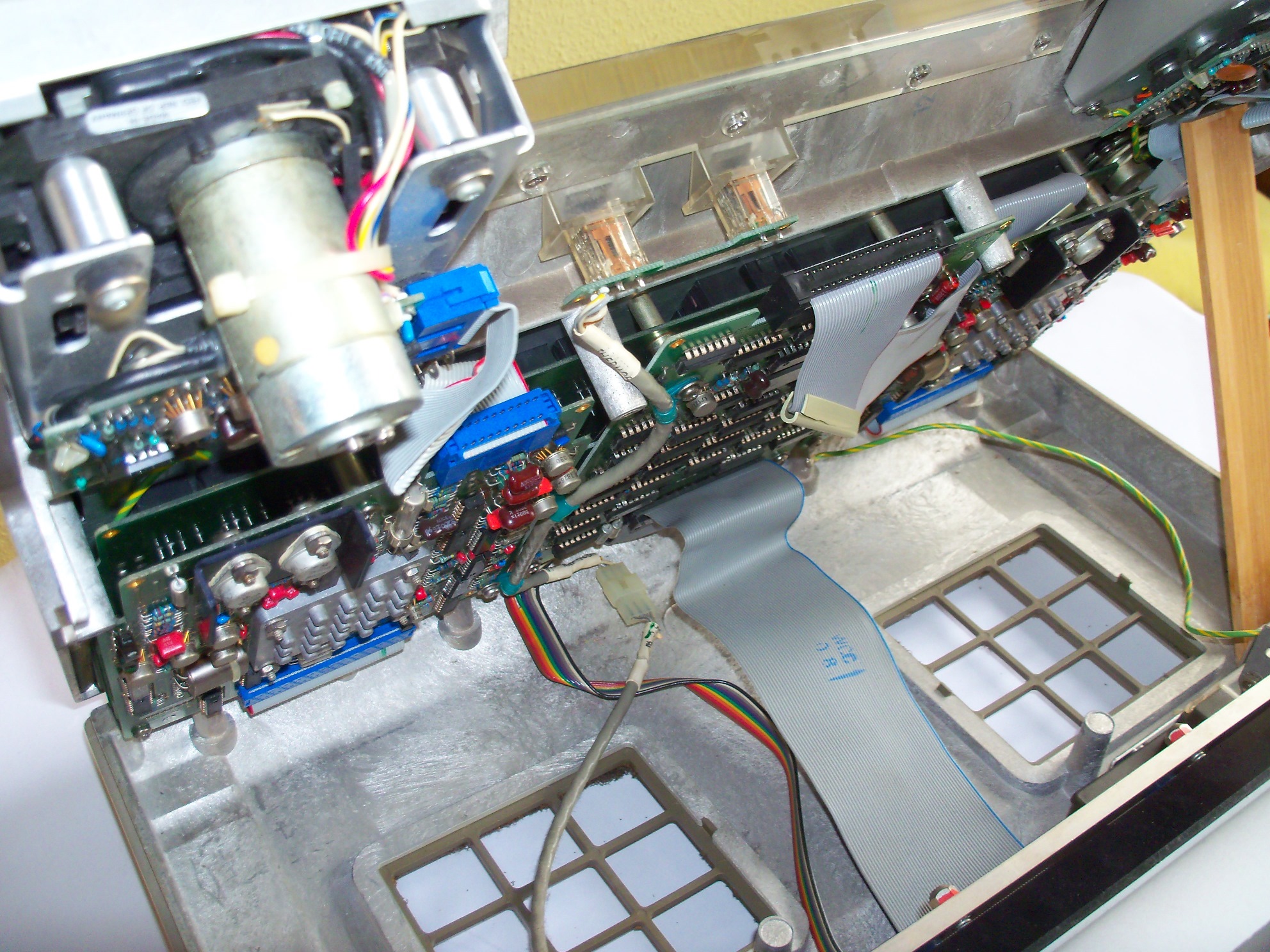 |
Below the keyboard/tape drive unit are the air inlets, through which the air is drawn into the system. Originally, those inlets are armed with exchangeable air filters in order to prevent dust being moved inside the system. Those filters are made of foam and have totally desintegrated through the time. However if you like, you can replace them with new ones. |
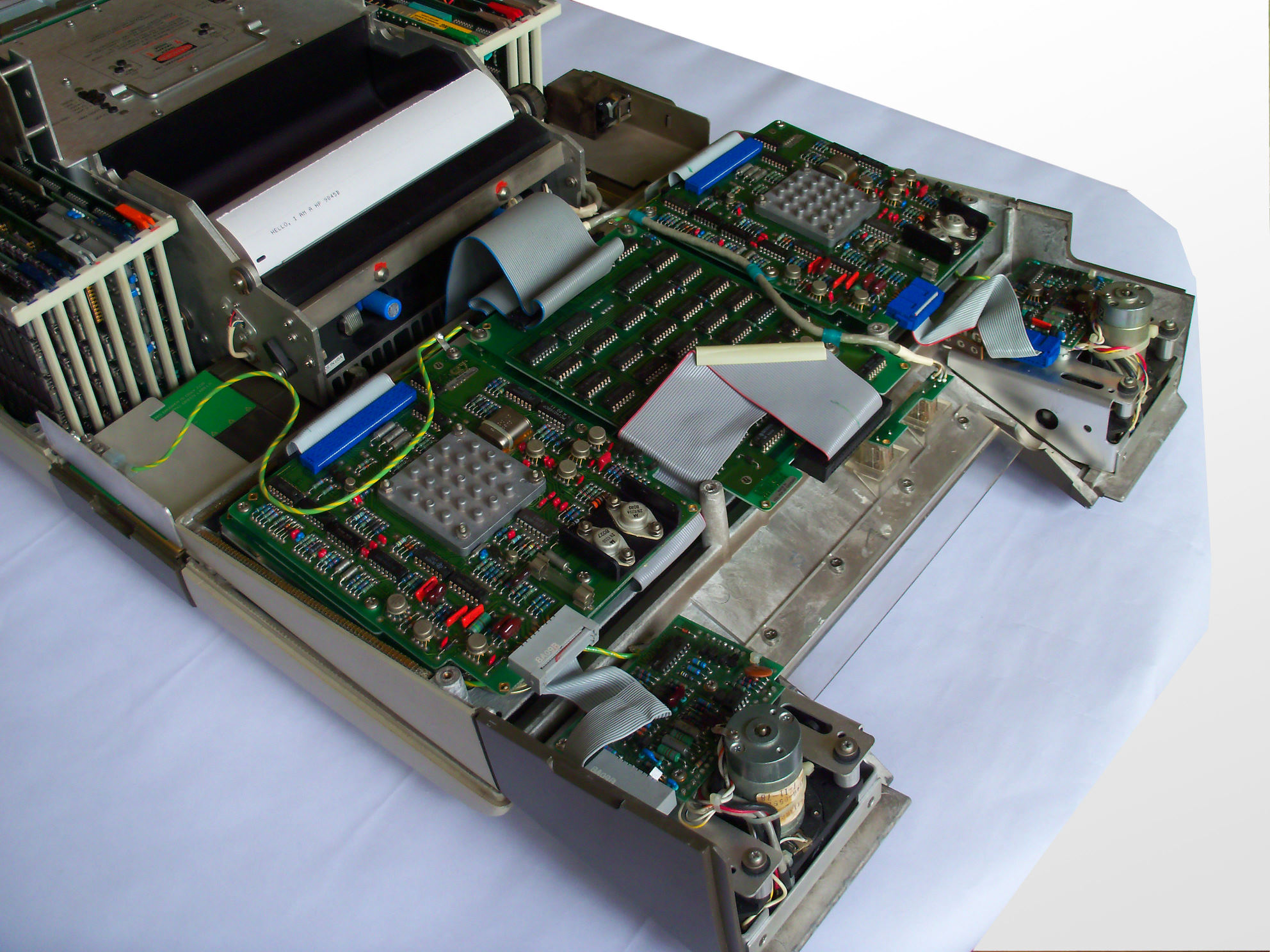 |
The keyboard/tape drive unit can be fully folded so that the assemblies can easily be accessed. The unit consists of the following assemblies: tape cartridge drive controllers (those with the heat sinks on it, one for each drive) |
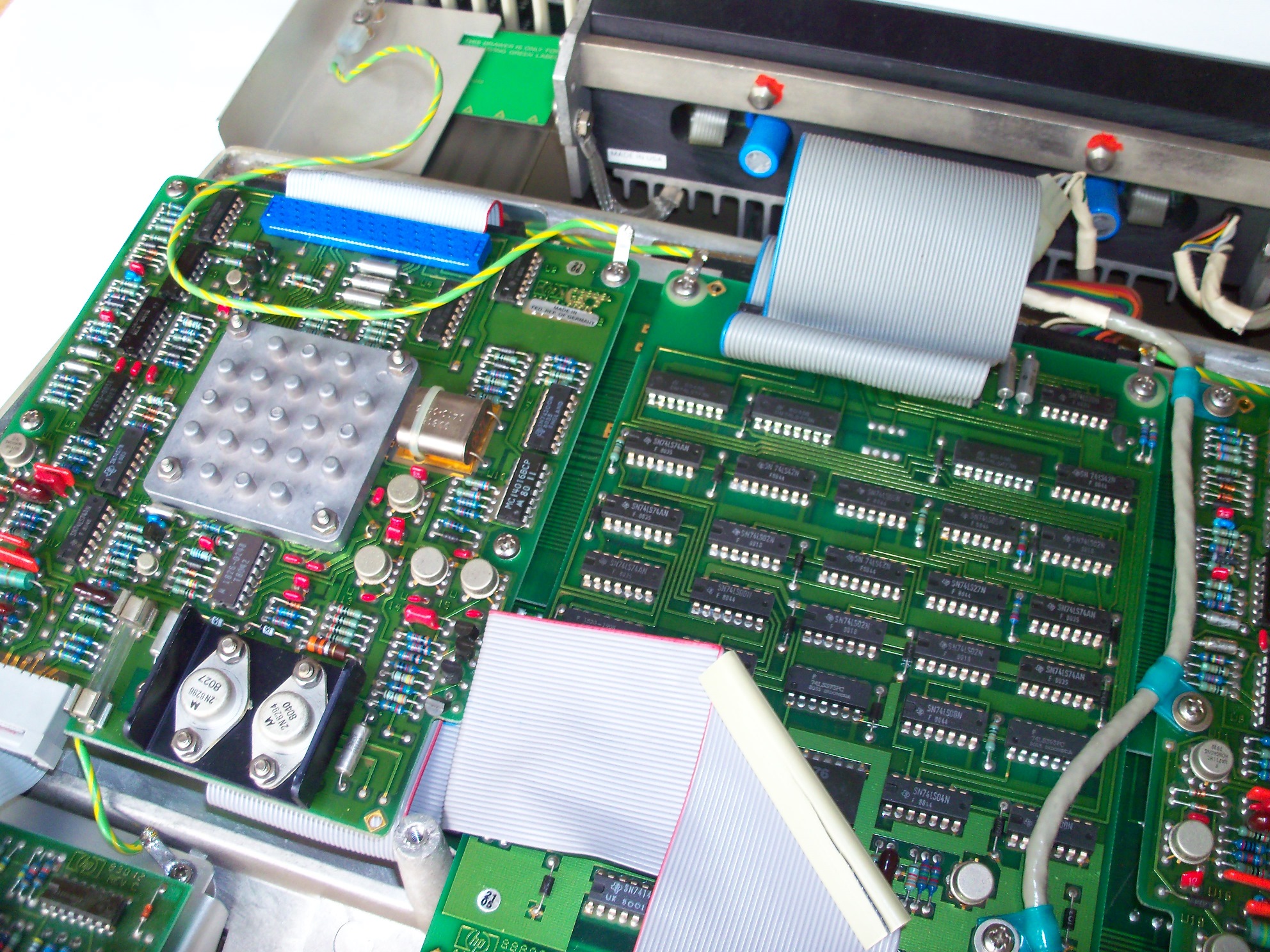 |
The keyboard controller board is connected with a ribbon cable to the interconnect board below, which again is connected to the rest of the system with another ribbon cable. Those ribbon cables often cause interconnect problems. If key won't work, this goes in estimated 95% of the cases to those ribbon cables with their connectors. |
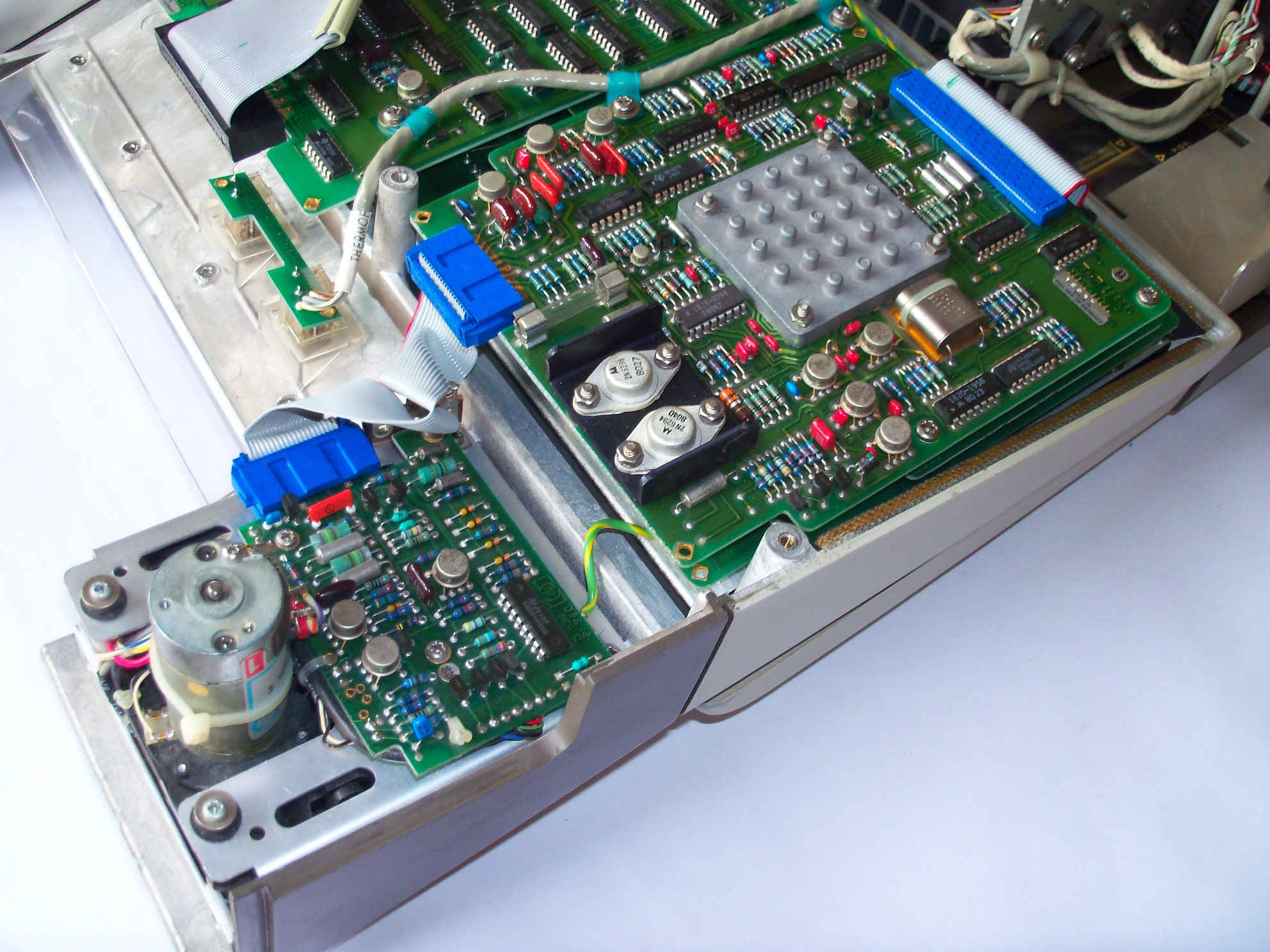 |
The tape controller assemblies use the TACO tape controller LSI chip. It does almost everything, from interfacing to the system I/O bus, signal encoding/decoding and tape data tracking up to the control of the tape movement. |
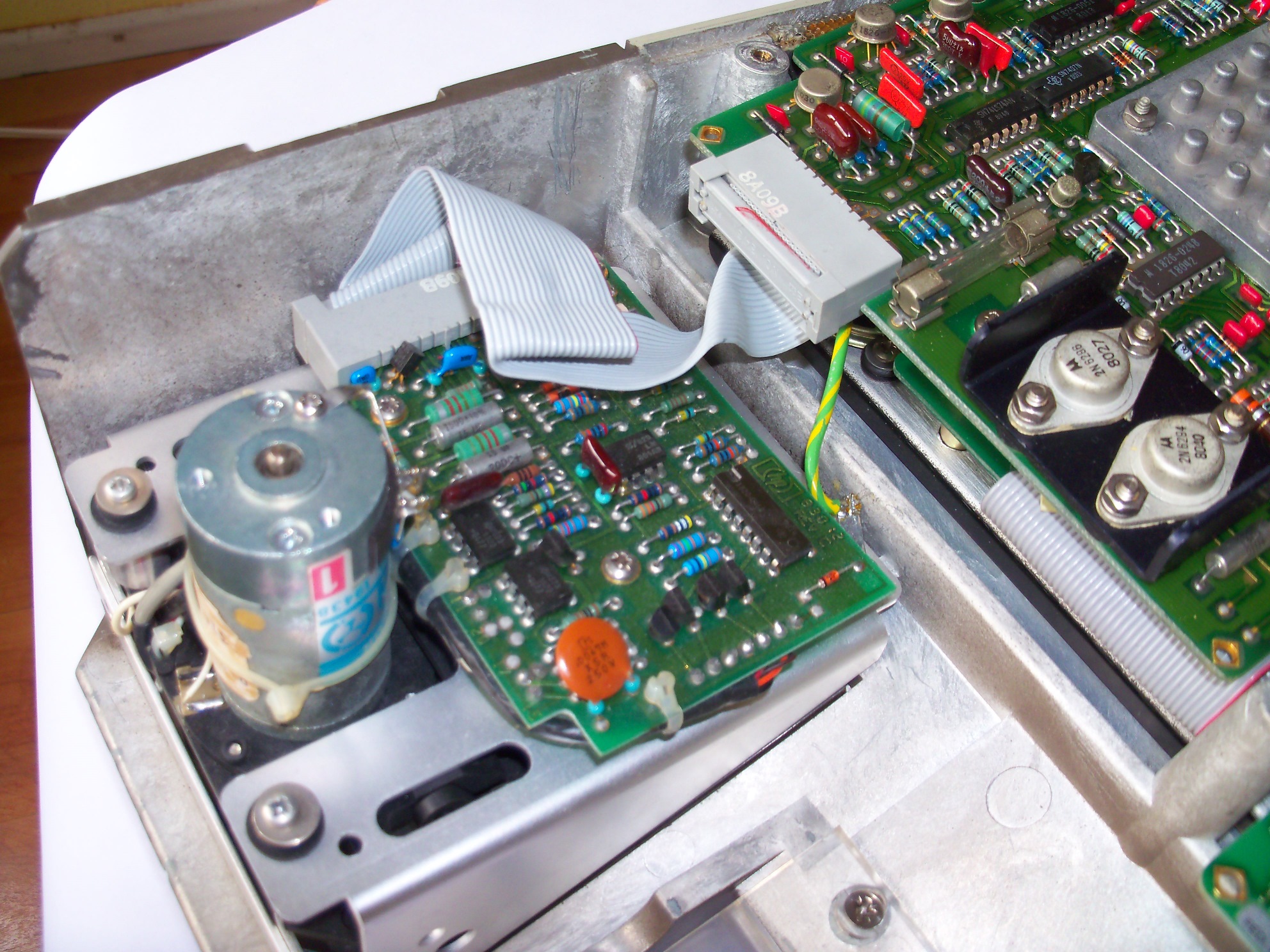 |
The tape drive assembly holds the analog part of the tape subsystem, including the analog signal processing, the capstan motor and the drive mechanism. |
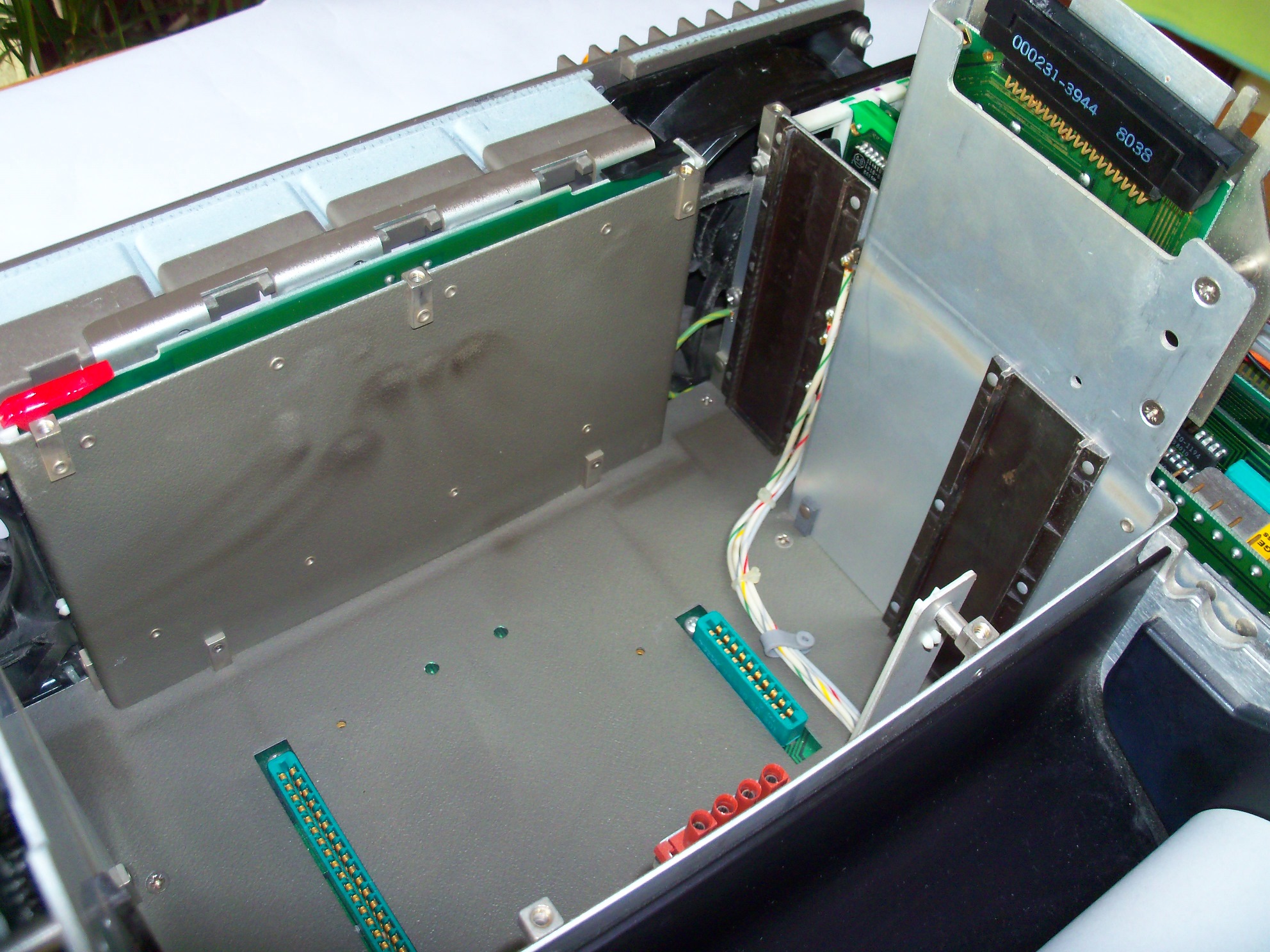 |
There is only one single PSU in each 9845B for supplying power to all internal components. As with all other components, the PSU is a subsystems which can easily removed from the system, not even one single cable has to be detached. |
 |
The PSU gets its 150V AC input from a four-contact MATE-N-LOK connector. The input voltage has been normalized before, so that it is independent of the main power input (110 or 220V AC). The voltages needed by the system components are provided via two edge connectors on the bottom of the PSU bay. A number of guidances assure proper alignment when installing the PSU into the system. The PSU bay is well-shielded against the other components. |
 |
The 9845B standard power supply unit consists of five PCBs mounted to gether to one compact assembly. The MATE-N-LOK connector in the front matches to that in the PSU bay. The yellowish WIMA epoxy capacitor next to it already has replaced the original capacitor, which is highly recommended for all epoxy capacitors used in the PSU and the line filter of a 9845. |
Model 200 Close Up
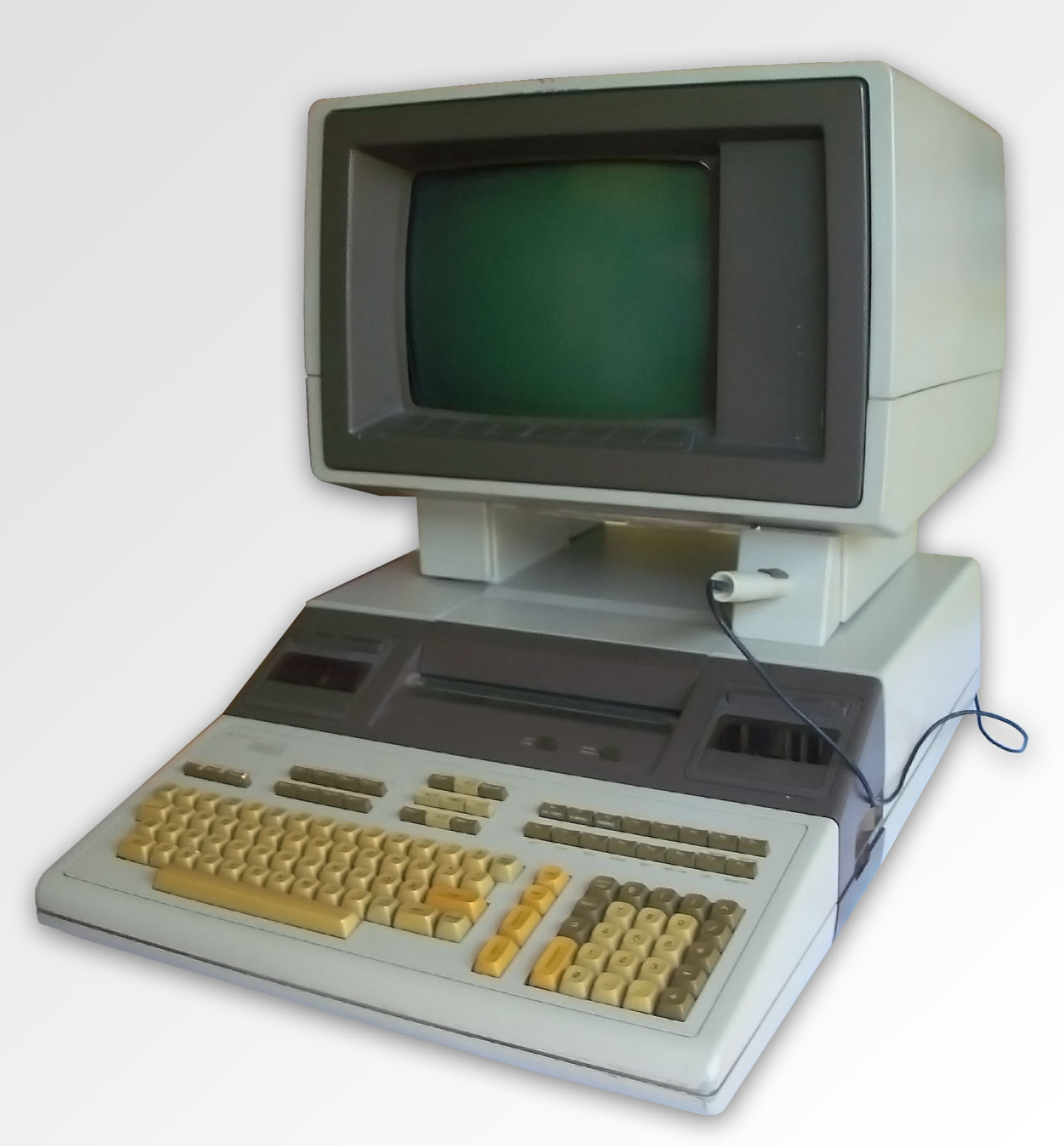 |
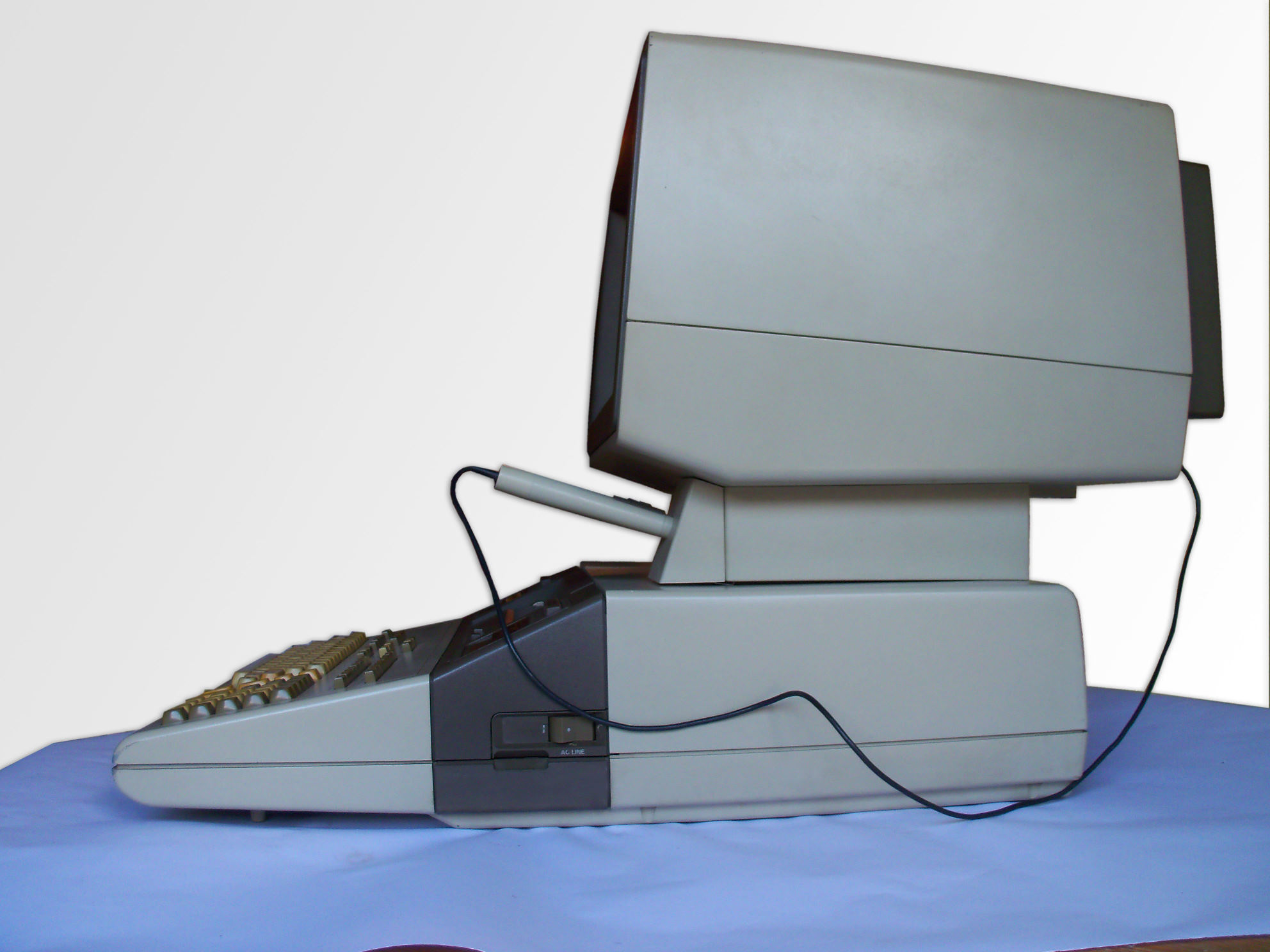
The HP 9845 model 200 is basically a normal HP 9845B, but with a couple of enhancements: Most obvious, there is a larger monitor which replaces the standard 98750A monitor. For 9845B systems this is a 98780A monochrome monitor, for 9845C systems this is a 98770A color monitor. Another difference visible from outside is the (optional) light pen. |
 |
Just like the 98750A standard monitor, the 98780A display draws its power from the mainframe's PSU. However, since power consumption is significant higher, the standard PSU is not sufficient any more, so that HP engineers designed an even more powerful switching supply, which still fits in the PSU bay of the system. |
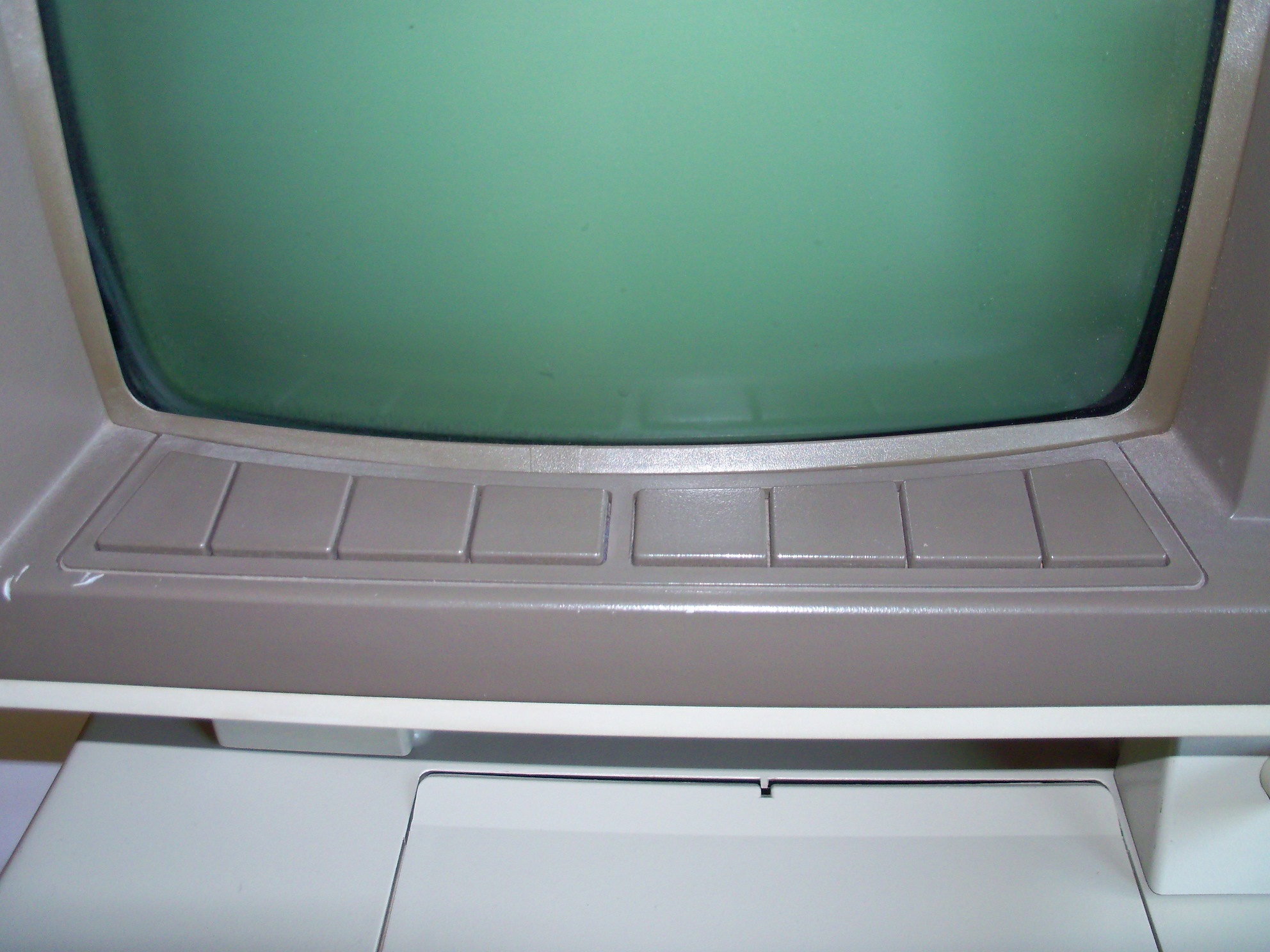 |
The 98780A monochrome and the 98770A color monitor both provide eight so-called soft-keys on the front bezel. Those keys are intended to correspond with labels which are dynamically shown on the bottom lines of the display, so that especially selection menus could easily be implemented. |
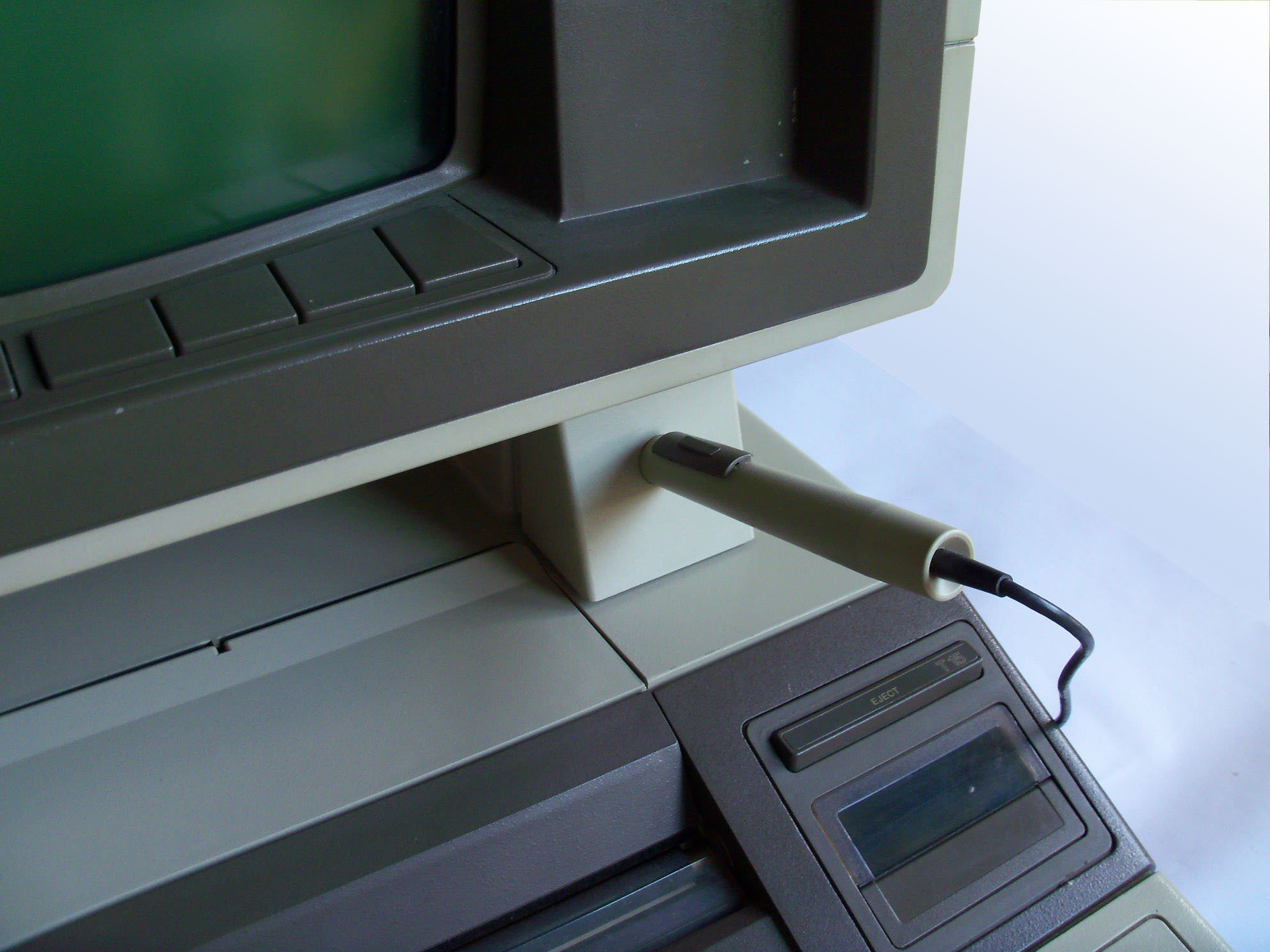 |
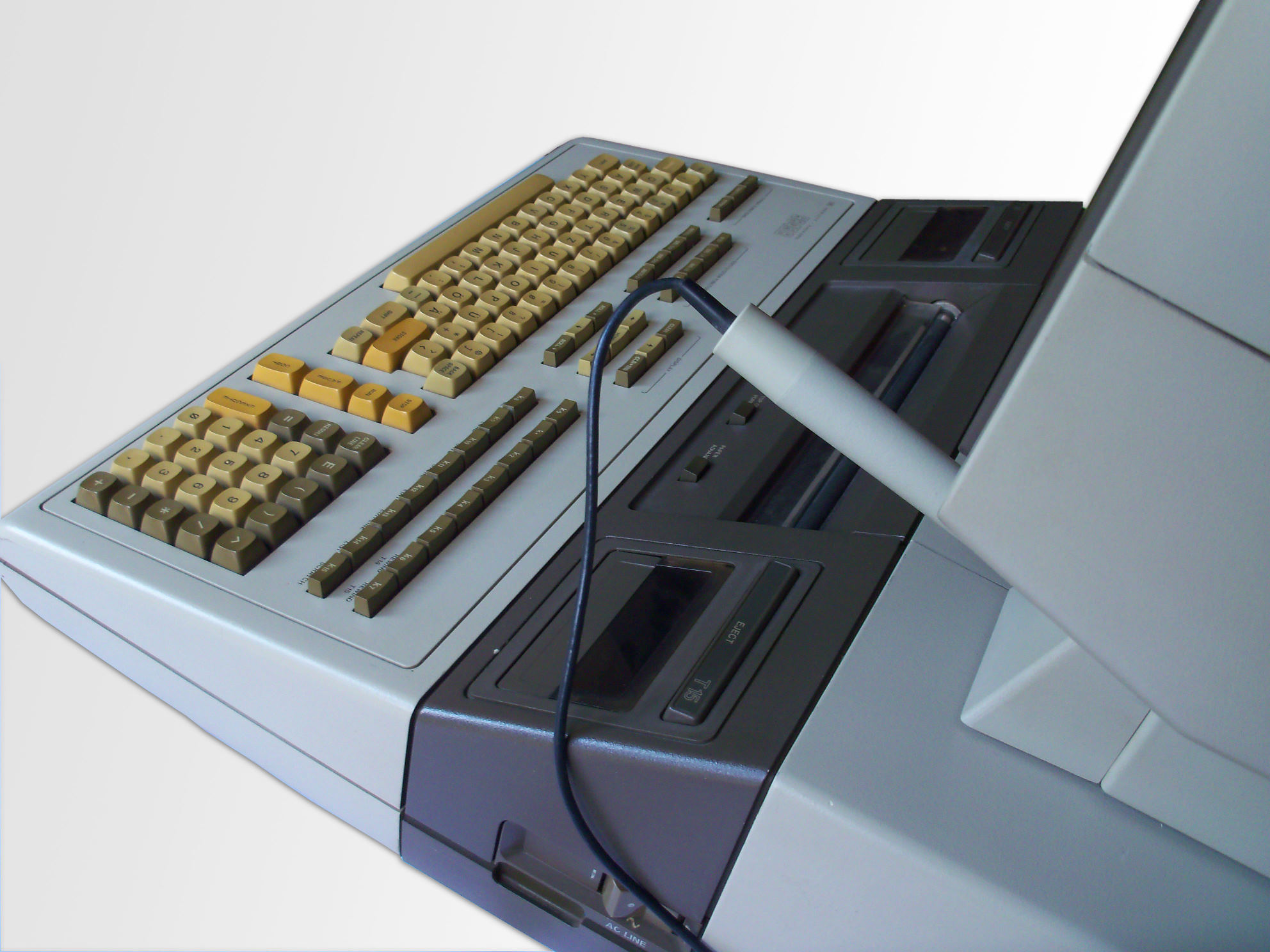
The light pen has its home on one of the monitor legs (you can chose on your own whether it should be the left or right leg since there is a detachable sleeve where the pen is put in). The light pen can be used to point and select items on the screen. Because the light pen needs light there is a special cursor which can be used as light source for the pen sensor. The light pen itself only includes the lense, the sensor and the trigger switch for selections. All other electronics are on a special light pen controller board inside of the monitor. |
 |
|
 |
|
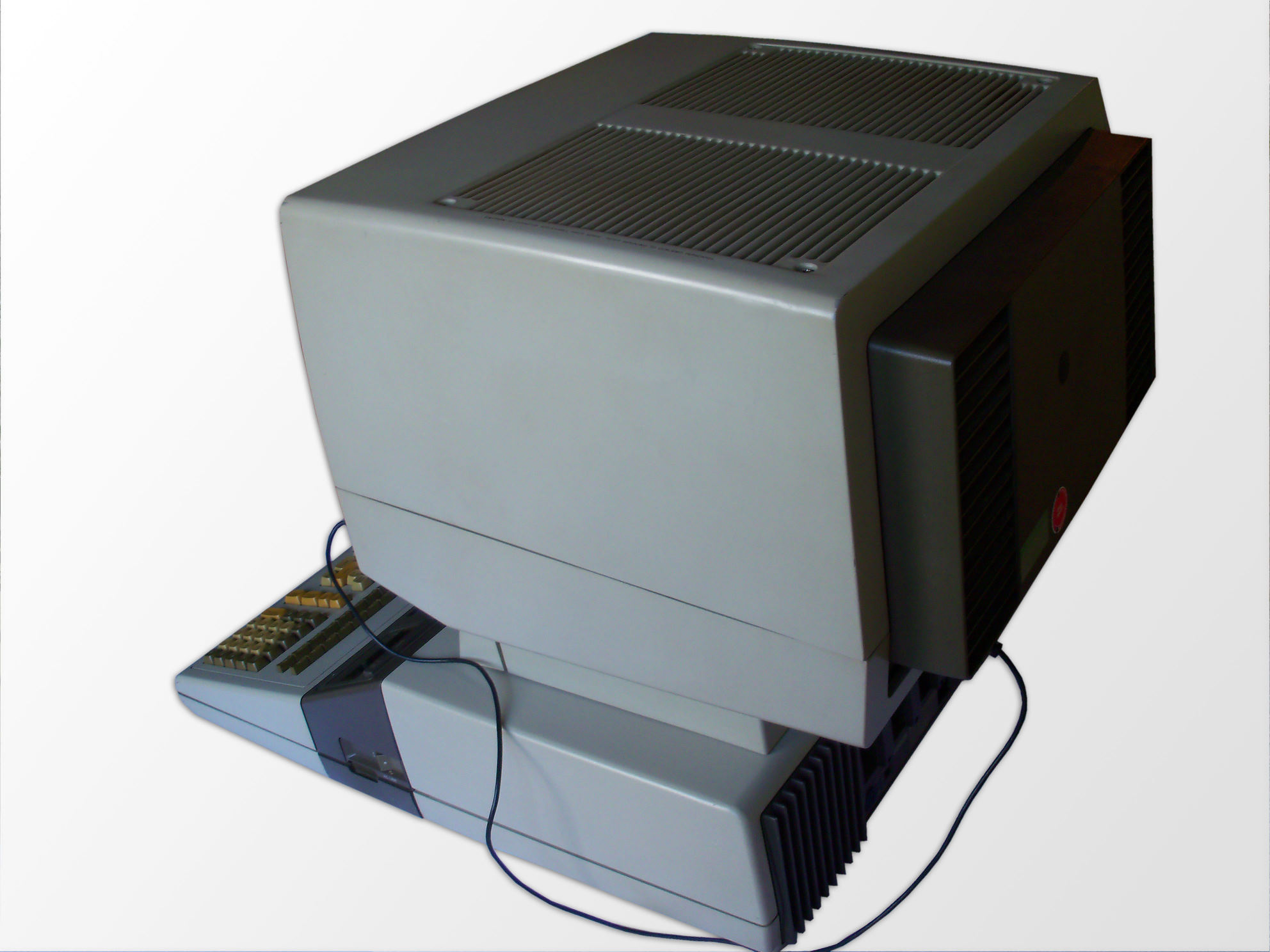 |
As visible on this picture, the 98780A monitor is quite bulky. In fact integration scale is not as high as that of the mainframe, since the 98780A uses the same casing as the 98770A but without own PSU and fans and with less components inside. So there is much space in the monitor, and it is not as heavy as it looks like. The 98780A monitor already supports monochrome graphics as standard, so that there has no graphics option to be ordered separately. Also, the graphics controller already includes a fast vector generator which (since only monochrome date has to be written) draws vectors even faster than that of the 98770A color monitor. |
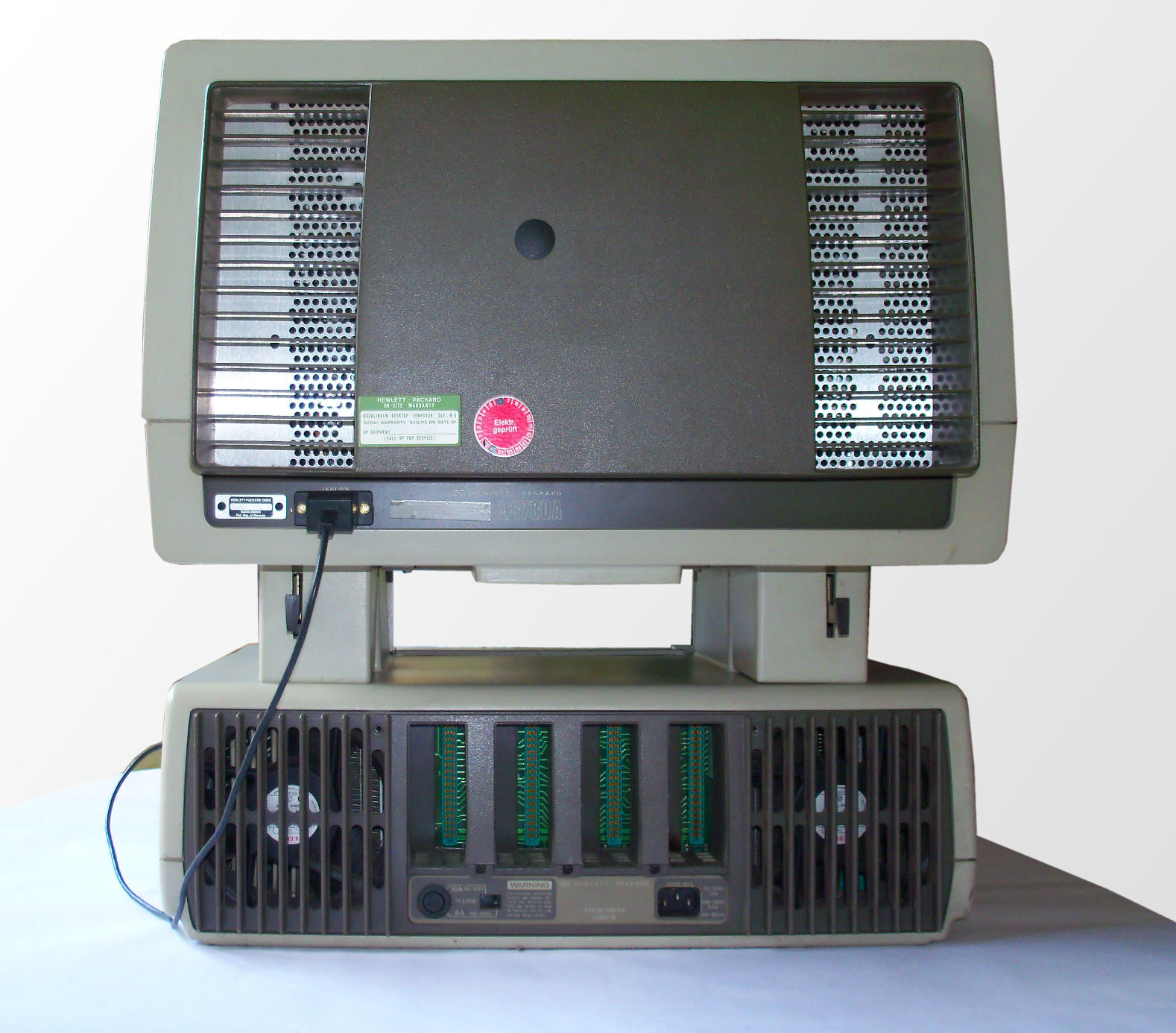 |
The 9845B model 200 fans are more powerful (and noisy) than their 9845B model 100 counterparts. The 9845B model 200 monitor is cooled by convection, there is no fan installed. The four I/O expansion slots are identical to those of the 9845B model 100. |
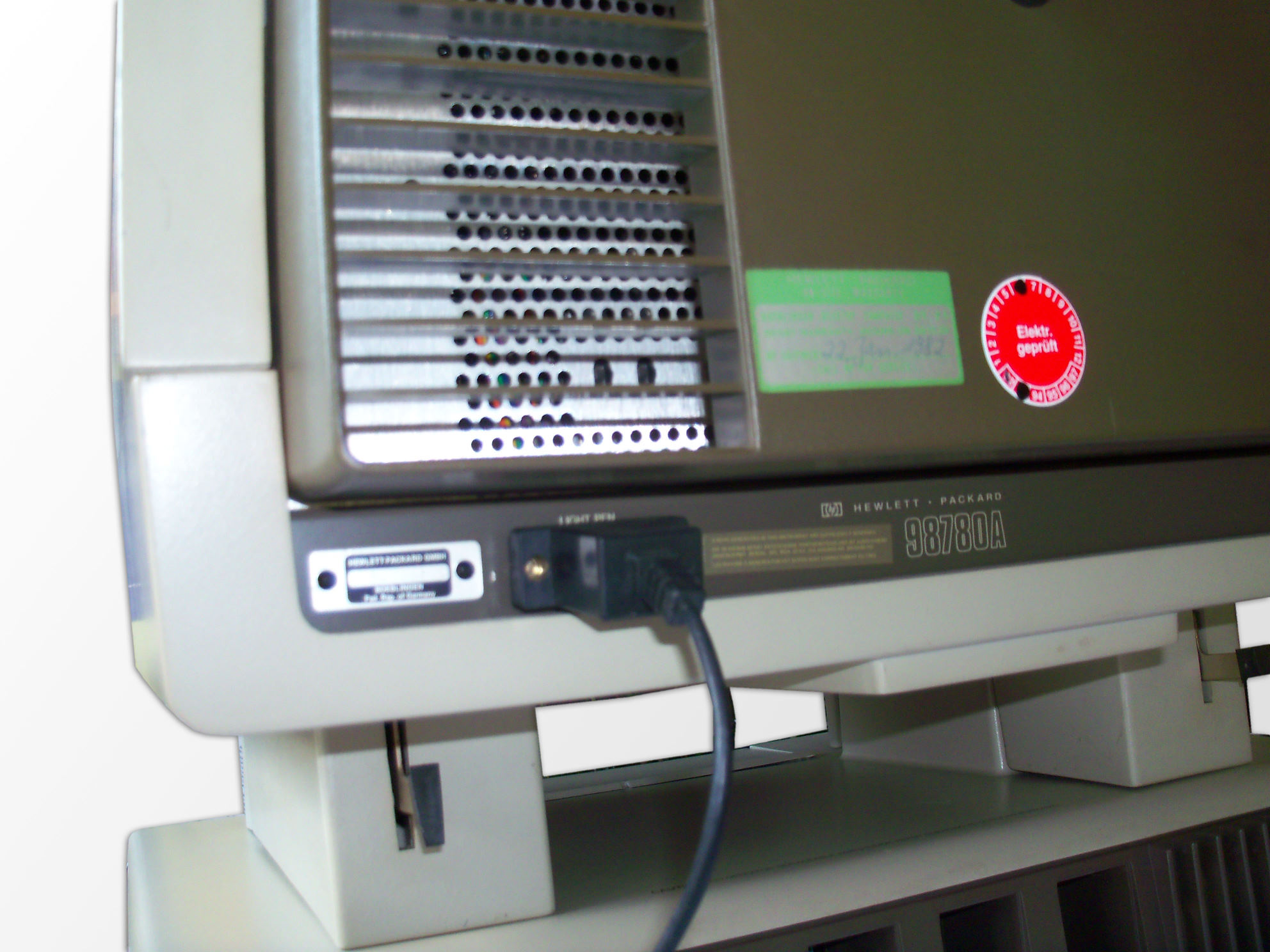 |
The light pen connects to a SUB-D connector at the back of the monitor. The connector again connects to a large light pen controller board inside of the monitor. The signal from the light pen is compared in real time to the CRT beam position, which again is reported to the program which uses the position information e.g. for selections or drawing operations. |
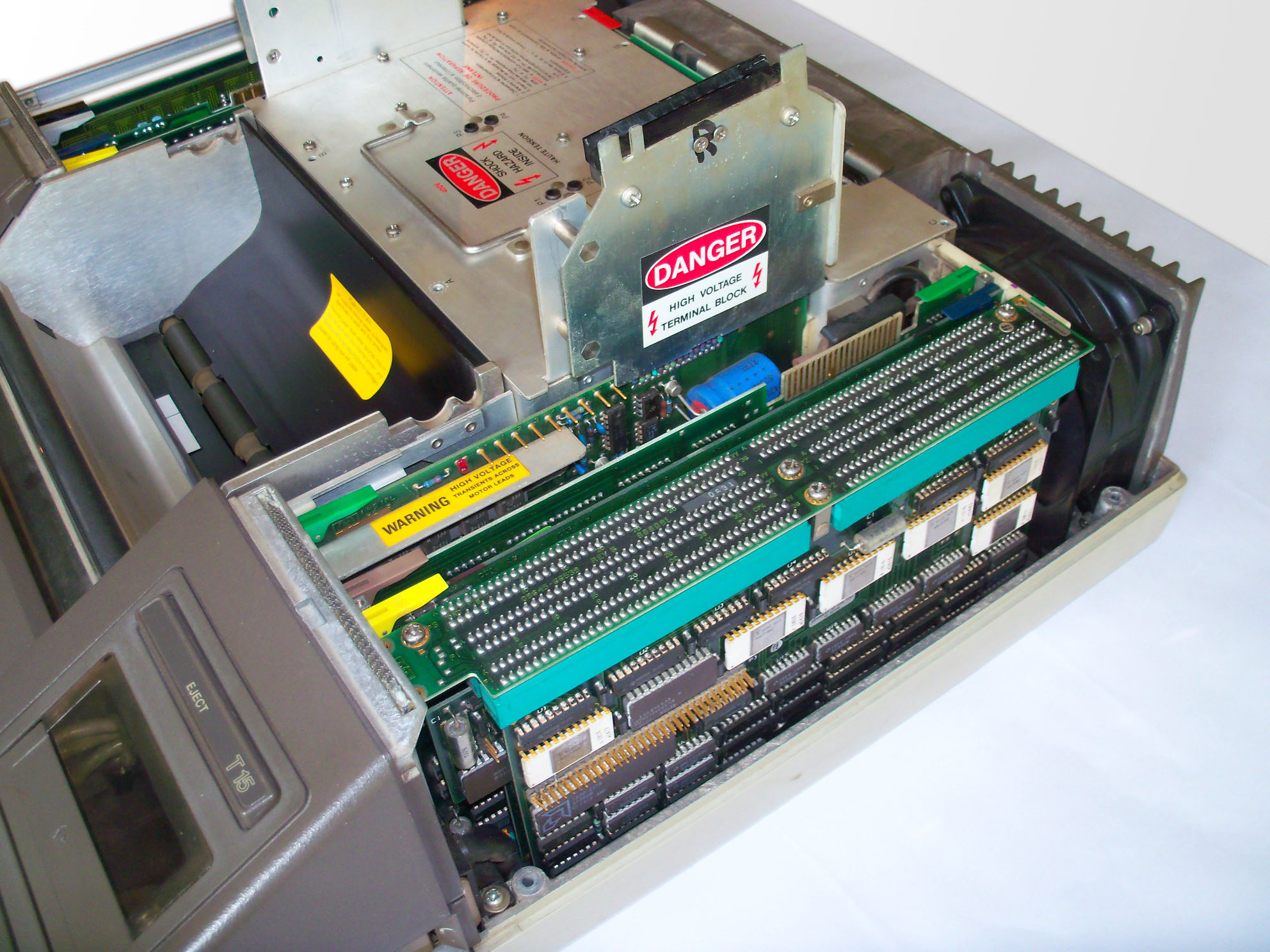 |
The new graphics capabilities, the larger screen, light pen and soft keys are not the only enhancements of the model 200. It also includes a faster LPU, which is based on a fast bit-slice design with some diskrete logic. The new CPU does not need a heat sink any more, however is distributed over four (!) PCBs. Again HP's engineers did the magic to get this still into the volume previously occupied by the standard LPU. The new LPU is slot-compatible with the old, so electrically they are interchangeable. However the new CPU consumes more power, so that a new PSU is needed, too. |
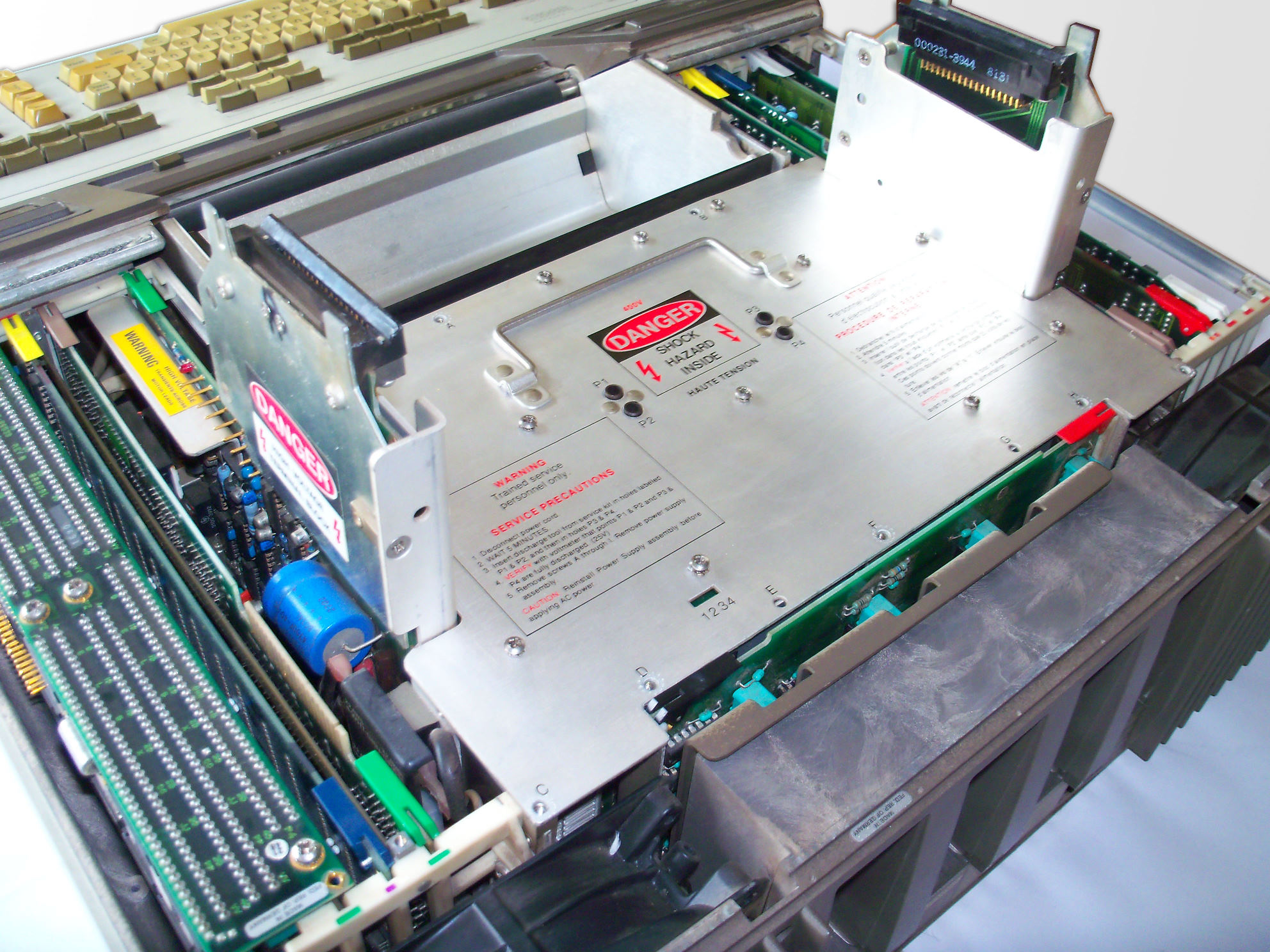 |
The new PSU which provides the necessary additional power for the fast processor and the 98780A display is installed at the same place as the standard PSU before. The test point have been replaced by a power-good sensor circuit with four LEDs. During operation, all four LEDs should be lit. Just with the fast LPU, exchanging the old PSU against the enhanced one is just a matter of minutes and a small number of moves. For transporting more thermal energy out of the system, the model 200 also incorporates more powerful (and significantly more noisy) fans in the mainframe. |
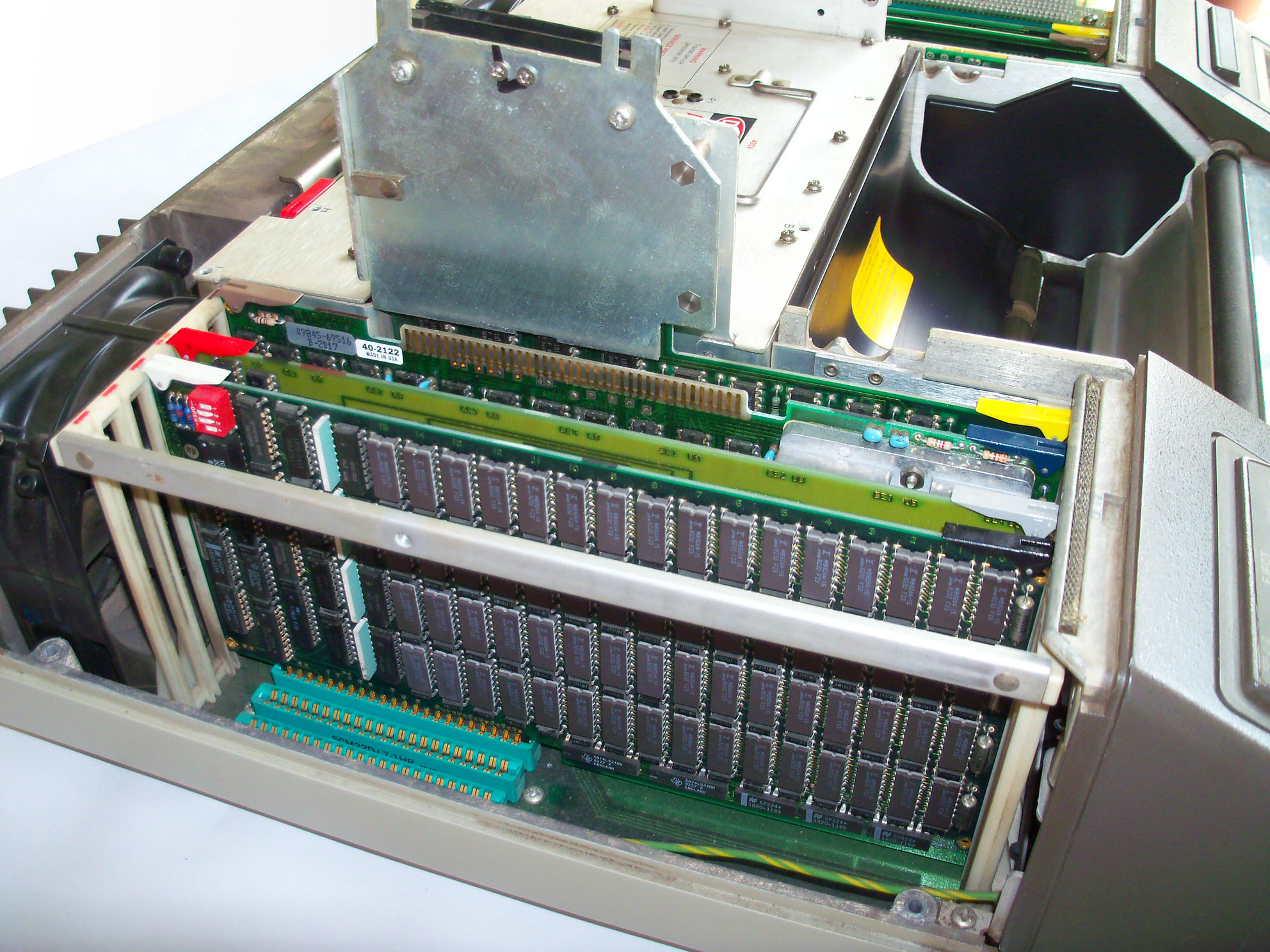 |
The model 200 already has built-in system ROM support for the new larger 512k memory boards, of which one is shown here. Up to three of those boards could be installed, so that up to 1.5 MBytes of RAM could be used by user programs (especially useful for large data base applications). |
Special TEMPEST Edition
U.S. government once had (and still has) special requirements for computer equipment used in security sensitive environments. Especially what is called leaking emanations can be a problem in terms of vulnerability against spy attacks. So NSA and DoD started quite early already during the mid-1950s to create the first standards against compromising emanations and launched the TEMPEST program, which continues until today for hardening and certification of computer equipment against spy attacks within NATO and the information-security agencies of many of its member states.
One of the largest suppliers for TEMPEST computer equipment for the U.S. government during the 1980s was WANG, also one of the strongest competitors of HP at the time. However very little is known about HP as supplier of this special type of equipment. It is mentioned in the October 15, 1982 issue of HP Computer News that a TEMPEST modified version of a HP9826A had been offered by Resdel Engineering Corporation in Pasadena, CA.
At least one modified HP9845B system appeared this year (2017) on eBay, for the suggested price of 3,999 USD.

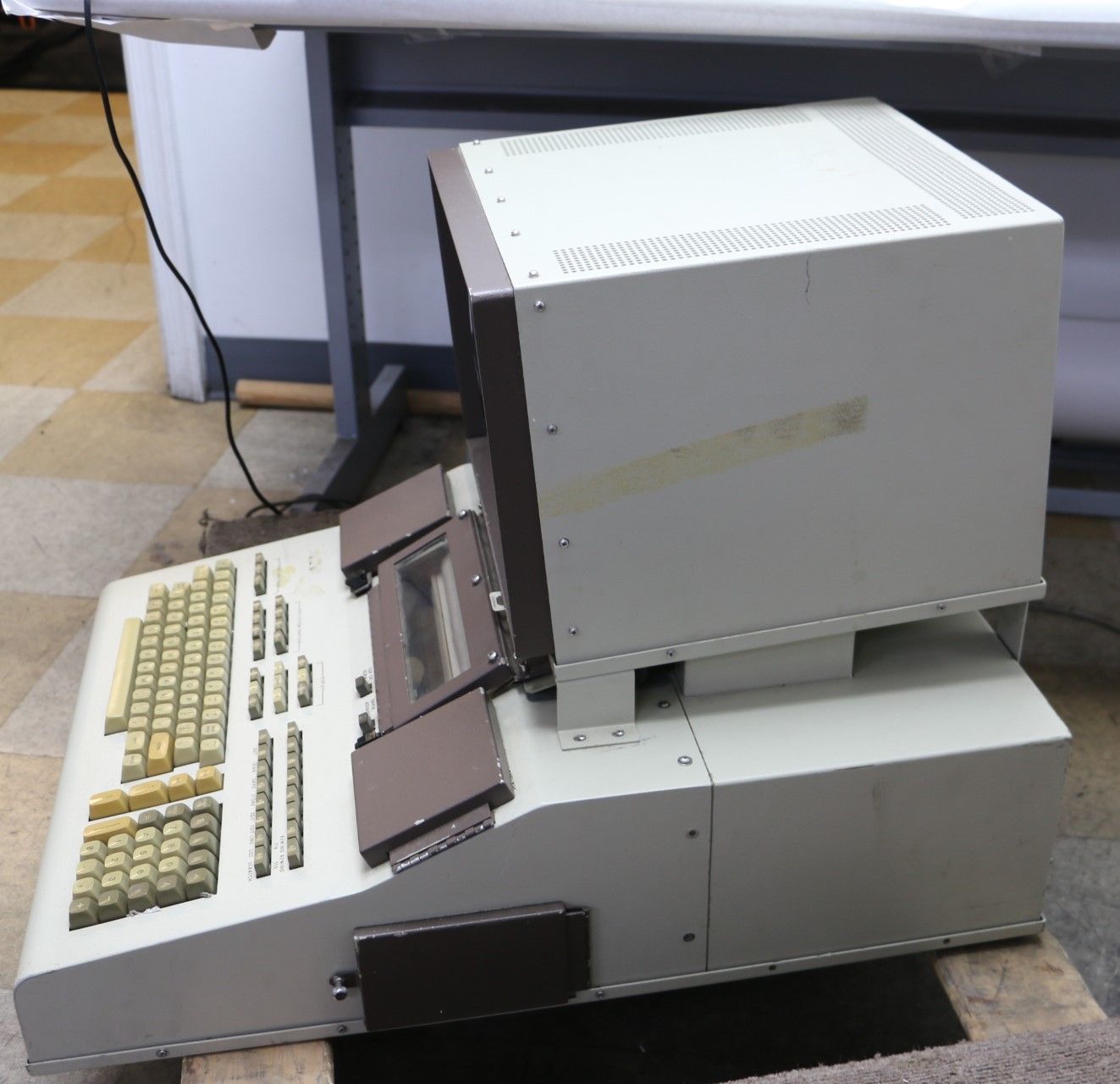
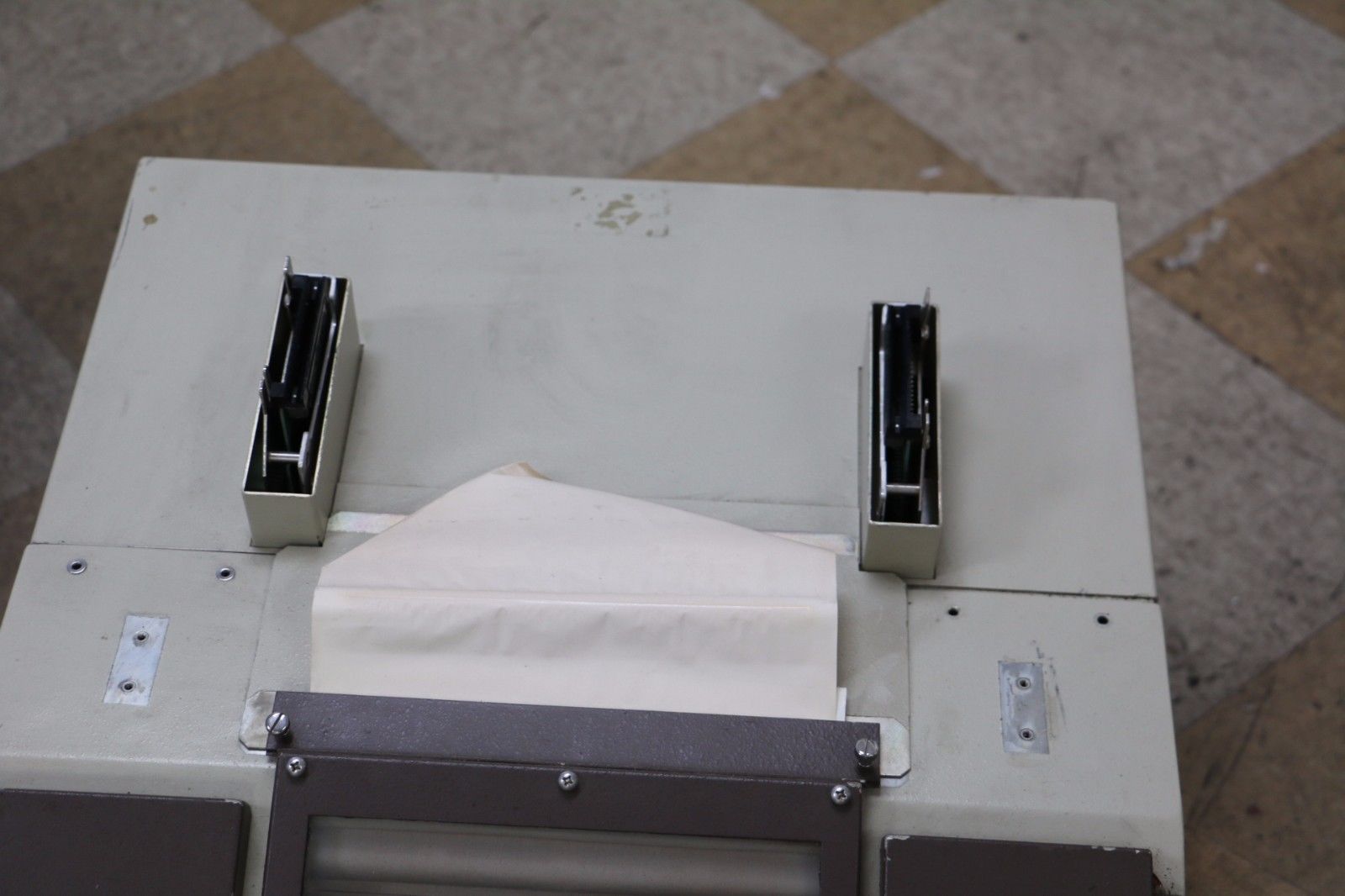
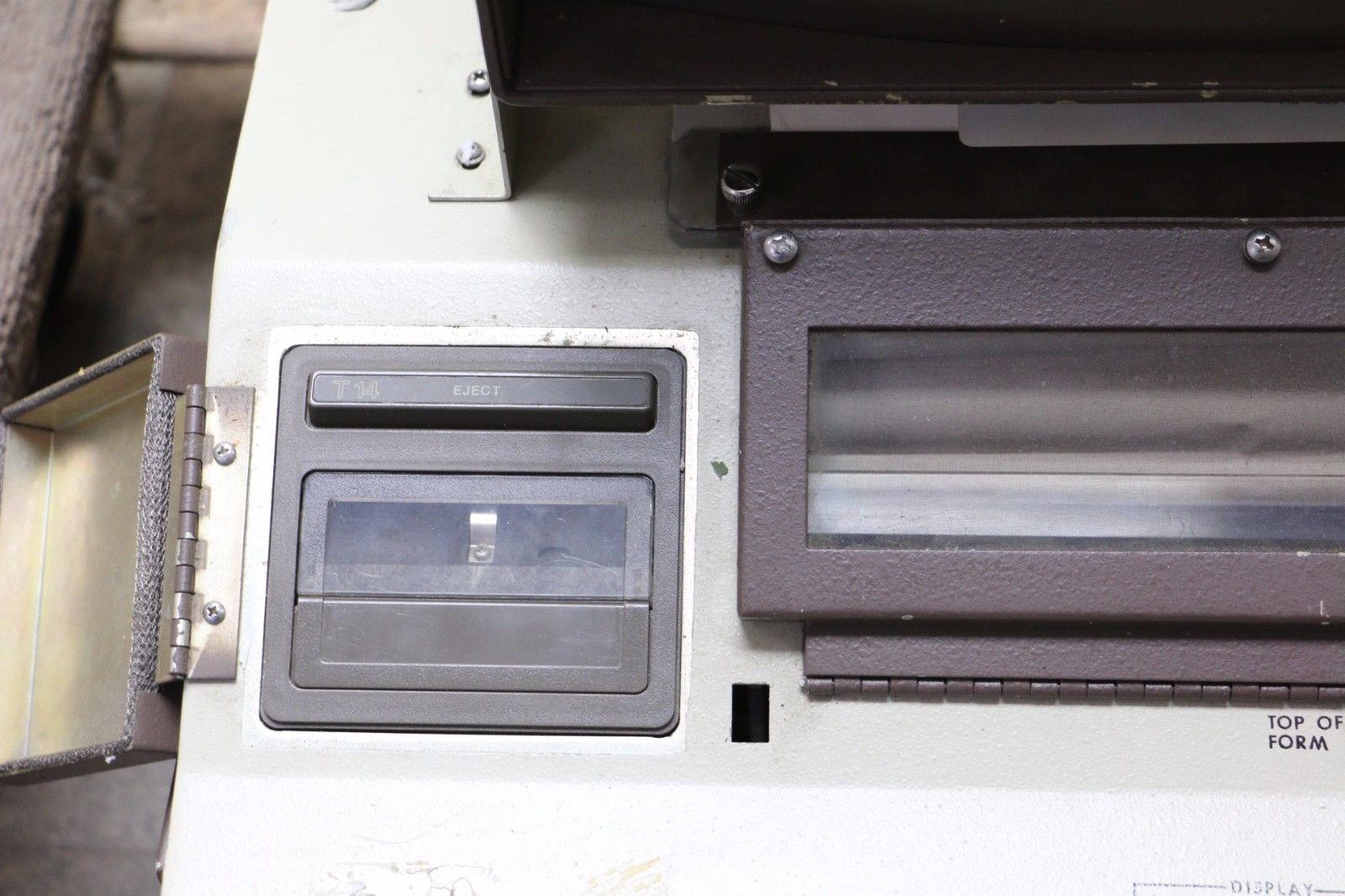
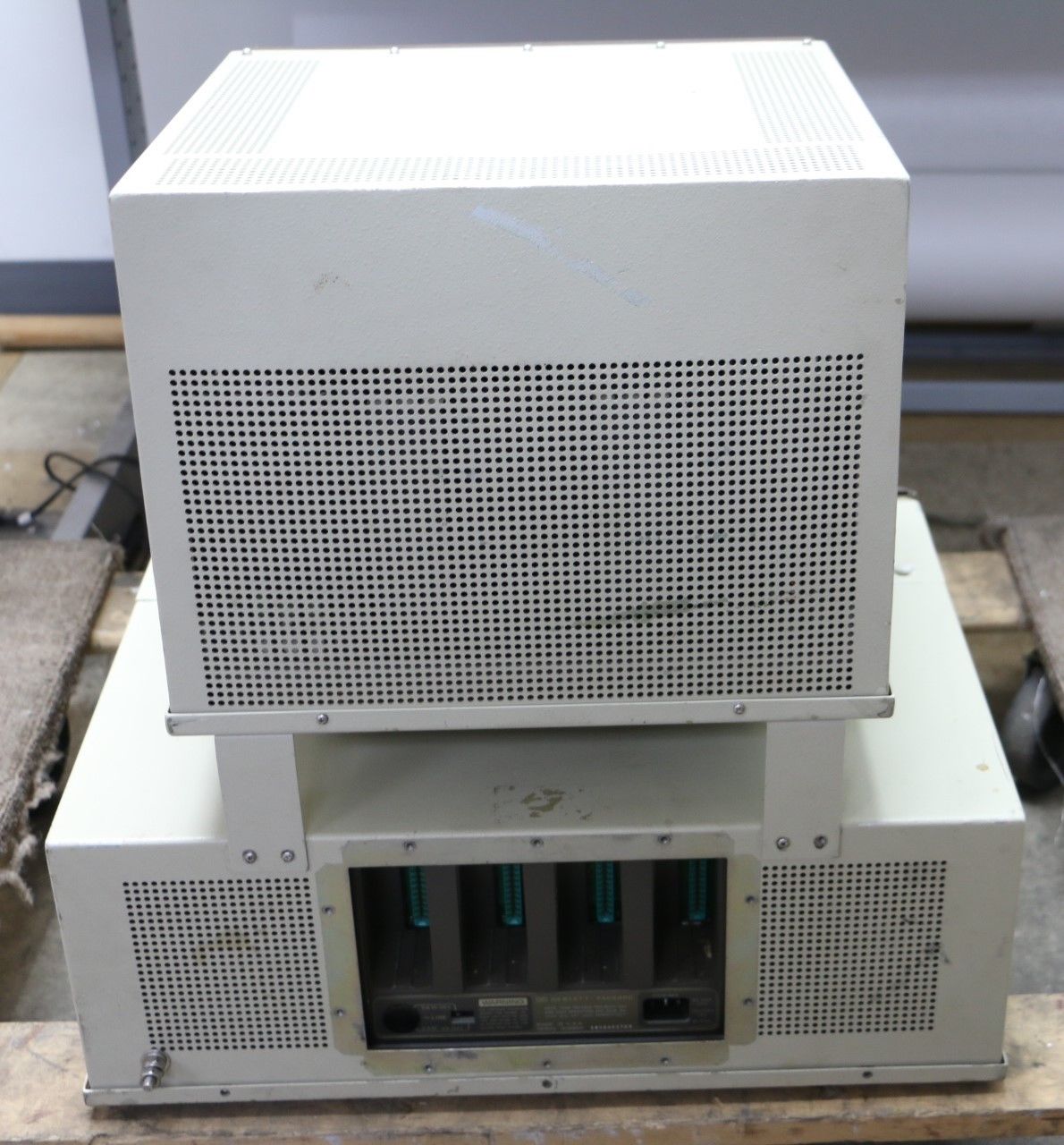
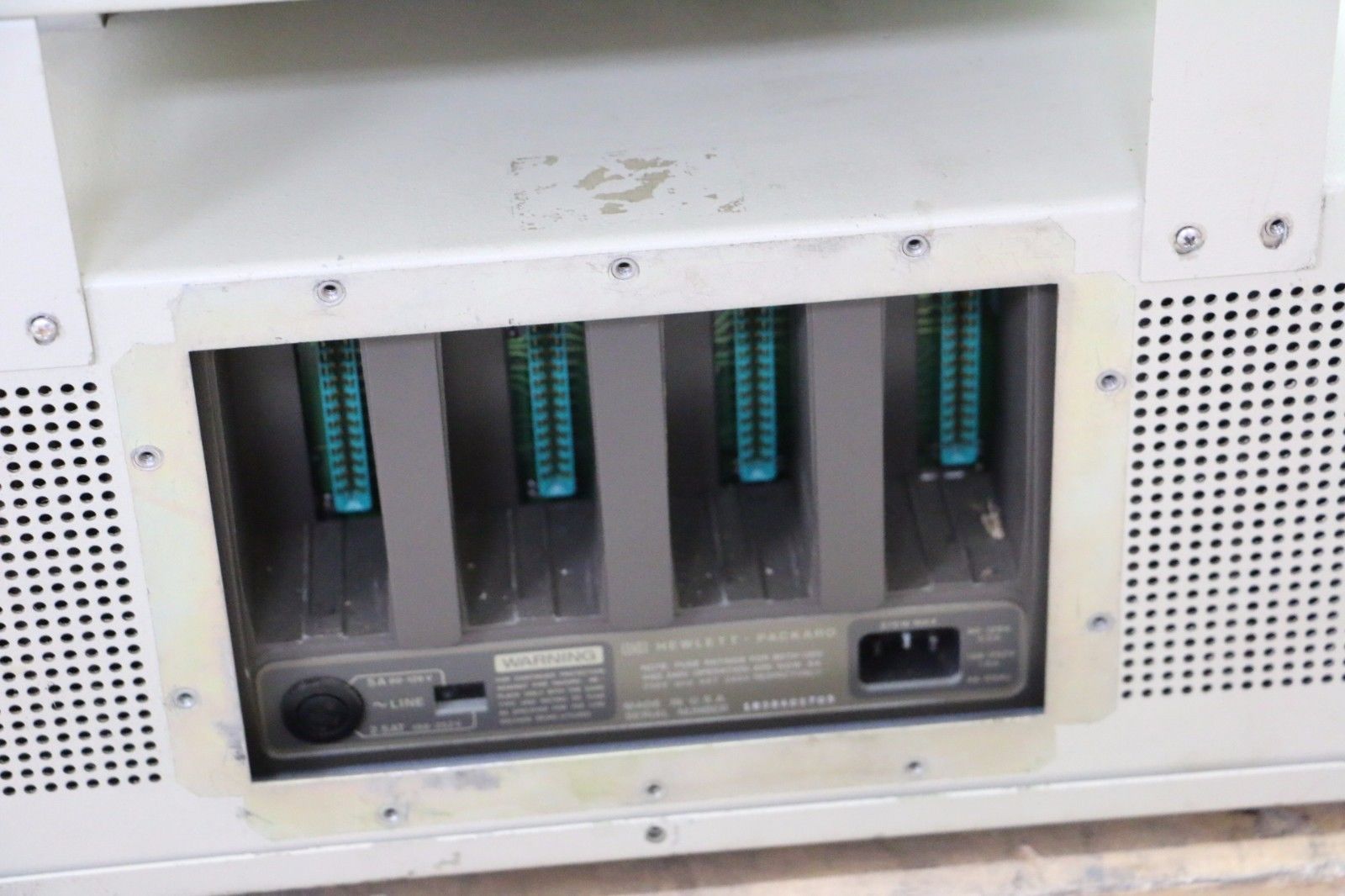

HP9845B TEMPEST Edition (Pictures With Kind Permission of Potomac eStore, Click to Enlarge)
Typical countermeasures were:
- In place of the conventional plastic housing, a metal case is used for the mainframe part. The parts of the housing are made so that there is an overlap of metal at each seam and the seams are welded together with no gaps. A braided metal wire ground is secured to an unpainted surface of the metal base.
- The main power supply switch, fuse, and electrical RF filter are enclosed in a metal box that is grounded to a paint-free surface.
- A flexible EMI gasket is fitted around the face of the CRT to seal the opening when the cover is in place. The CRT anode, the screen, would be metal coated, preferably gold, and the face of the CRT is covered with a metal-coated mesh with an antireflection coating.
- An EMI gasket is placed in a groove in the metal base of the unit into which the top housing fits securely.
- The keyboard in its metal housing is surrounded by an EMI gasket, and the keys are coated with a metallic vapor or covered with a formed metal-coated film.
- Any printed circuit boards used within the mainframe are encased in a metal cage grounded to the metal base. The more security-sensitive boards are placed away from the outside of the unit. The cable connectors are grounded against the board cage and not the base of the unit.
- The high voltage supply needed by the CRT is shielded in a metal unit and grounded to the base unit.
- Ventilation is provided by louvered slits in the top or back of the unit with an EMI underscreen or special honeycomb unit.
Tempest certification must apply to entire systems, not just to individual components, since connecting a single unshielded component (such as a cable or device) to an otherwise secure system could dramatically alter the system RF characteristics.
More Information
Basic sales information about the 9845B can be found in the 9845B brochure from 1979 (look here for the brochure). The 9845B was never introduced in the HP Journal like it was done for the 9845A and the 9845C. Most internal information about the 9845B can be derived from the installation and operation manuals, the 9845B/C service manual and the CE handbook. See the Documents section for further details.
Although there is no special patent document for the 9845B, a complete 9845B model 200 has been reverse engineered by Tony Duell, so there are (really high quality) schematics available.